Delhi’s AQI Surges to 324; The 3 PM Blind Spot in Punjab-Haryana Stubble-Burning Data
Delhi AQI Today: Delhi has entered ‘very poor’ AQI today, as smoke from Punjab-Haryana stubble fires and north-westerly winds triggered GRAP Stage-II across NCR.
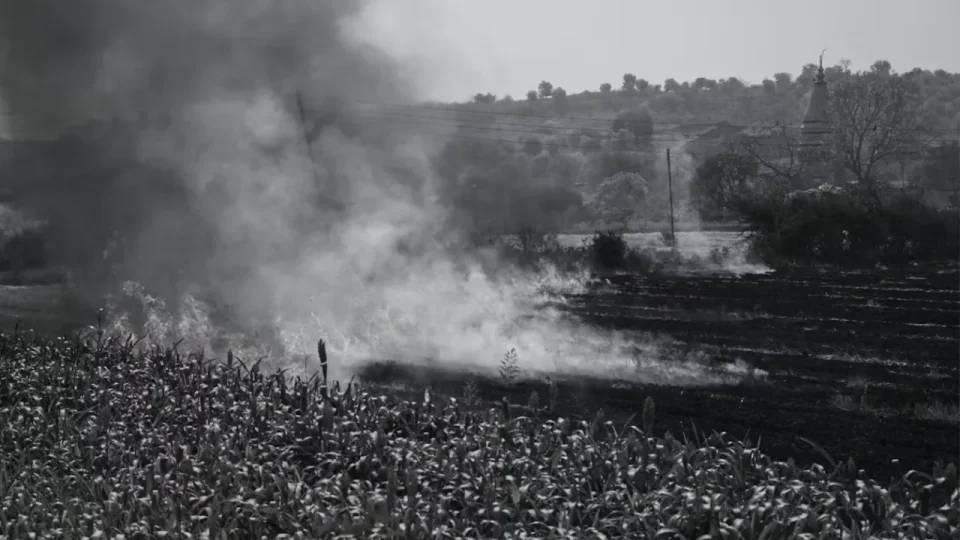
Delhi AQI Today: Smoke from stubble fires in Punjab and Haryana, carried into Delhi by north-westerly winds, drove the capital’s sudden pollution spike and pushed its air quality into the “very poor” category for the first time this season, according to weather and satellite data. The Commission for Air Quality Management (CAQM) took no time to invoke Stage-II restrictions under the Graded Response Action Plan (GRAP) across the National Capital Region (NCR).
Delhi’s Air Quality Index rose from 117 on October 31 to 261 on November 1, then reached 324 by 4 pm on November 2, according to CAQM data. The index had already crossed the “very poor” threshold of 300 by Monday morning (November 2), recording 312 at 9 am.
#AQI of #Delhi on 02.11.2026 at 4:00 PM (पिछले 24 घंटों का औसत) | https://t.co/anSmII73qm #GoGreenBreatheClean https://t.co/dn9KOHAfto
— Commission for Air Quality Management (@CAQM_Official)
What Triggered the Spike
It was reportedly found that Delhi’s overnight PM2.5 averaged 194 micrograms per cubic metre between 10 pm on November 1 and 6 am on November 2, more than three times India’s 24-hour limit of 60 micrograms. Yet on October 18 and October 28, when weather conditions were similarly poor or worse, overnight PM2.5 averaged 68 and 127, respectively, as analysed by the HT.
Also Read: Delhi Police Protest Against Transfer of Officers Under Pressure from Lawyers
The analysis used hourly readings from the Central Pollution Control Board’s CCR portal, weather-balloon and surface observations from the India Meteorological Department’s Safdarjung station, NASA FIRMS VIIRS fire data, and India’s INSAT-3DS geostationary satellite, thus concluding that pollution did not disperse in the afternoon on November 1, as it had on the cleaner October days, indicating that polluted air was arriving from outside Delhi.
Fires After the Satellite Pass
A key finding is that much of the burning occurred after the NASA satellite used for India’s standard stubble-fire count passed over Punjab at about 1.30 pm. According to HT, INSAT-3DS detected almost no evening fires from October 15 to 28, but its count rose from 17 on October 29 to 90 on November 1; because the geostationary satellite detects mainly larger or more intense fires, the actual number of burned fields was likely higher.
NASA’s own count also rose to 171 on November 1, the season’s highest; however, it is likely that the daily total does not reliably reflect the scale of burning because it is reportedly observed that farmers increasingly light fires after 3 pm, as also found by the iFOREST Stubble Burning Status Report 2025, that more than 90% of large fires in Punjab in 2024 and 2025 occurred after 3 pm, compared with 3% in 2021.
In a social media post by Hiren Jethva, Aerosol remote sensing scientist at Morgan State Univ/NASA Goddard Space Flight Center, stated the same about the stubble burning.
2. Actual fire statistics for 2022–2025 were multifold lower due to temporal shift in peak burning activity to late-aftenoon not sampled by 🛰️ #MODIS & #VIIRS. #GK2A #AMI geostationary observations, however, effectively captured the diurnal pattern.
— Hiren Jethva (@hjethva05)
Winds Carried the Smoke
Transport-level winds, roughly a few hundred metres to two kilometres above the surface, blew from the north-west on the afternoons of October 31 and November 1, according to Safdarjung balloon readings, as reported, cautioning that it could not quantify exactly how much of Delhi’s pollution came from smoke. High humidity after rain on October 29 and 30 may also have helped secondary fine-particle formation, although HT noted that humidity was similarly high on October 31, when the afternoon air was much cleaner.
GRAP-II Imposed
Citing the sharp deterioration and forecasts from the IMD and the Indian Institute of Tropical Meteorology, CAQM’s GRAP sub-committee ordered all Stage-II measures across NCR with immediate effect in its November 2 order. Stage-II applies when the AQI is between 301 and 400, and its measures are being implemented alongside Stage-I restrictions.
The curbs include higher parking charges, intensified mechanical road cleaning and water sprinkling, anti-smog guns, stricter action on construction dust and open waste burning, enhanced checks on polluting vehicles, and greater use of public transport. Agencies have also been directed to regulate diesel-generator use and inspect industries, brick kilns and power plants.
Delhi recorded a maximum temperature of 29.5 degrees Celsius at Safdarjung on Monday, one degree below normal, while the minimum was 16.4 degrees Celsius, 1.1 degrees above normal. No rainfall was recorded at any Delhi weather station in the 24 hours ending 5.30 pm.
दिल्ली में GRAP Stage-II लागू है। वायु प्रदूषण को कम करने के लिए सार्वजनिक परिवहन अपनाएँ, कूड़ा न जलाएँ, धूल नियंत्रण में सहयोग करें और दिए गए दिशा-निर्देशों का पालन करें। साथ निभाएँ, प्रदूषण घटाएँ! #DPCC #GRAPStageII #GRAP #CleanAirDelhi @CAQM_Official @CPCB_OFFICIAL https://t.co/FyGxVSktrI
— Delhi Pollution Control Committee (@DPCC_Pollution)
What do the Numbers Mean?
Under the CPCB scale, an AQI of 301–400 is “very poor,” and 401–500 is “severe.” CAQM said unfavourable meteorological conditions were likely to keep Delhi’s air in the “very poor” range in the coming days.
Therefore, evidence points to some probable factors: evening farm fires added to the fine-particle pollution, north-westerly transport winds moved it toward Delhi, and stagnant, humid conditions contributed to retaining it over the city. The satellite-timing gap, however, means official fire counts may understate the actual scale of stubble burning.