Manusmriti, Vedas, Kamdhenu Feature in Cow Slaughter Judgment Under Secular Law
Cow Slaughter Manusmriti Judgement: Judge refers to Manusmriti, Vedas and Kamdhenu while pronouncing life term for cow slaughter convicts under a secular law enacted for preservation of animals. The Constitution makers had taken note of similar laws during Mughals while incorporating Article 48 to make an endeavour to ban cow slaughter.
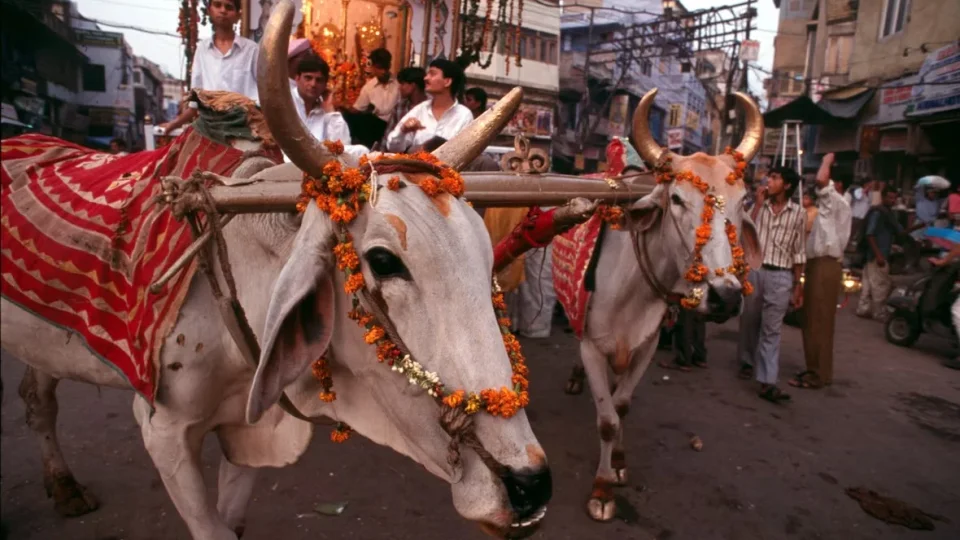
Cow Slaughter Manusmriti Judgement: A judgment by a Gujarat Sessions Court quoting Manusmriti and Vedas while sentencing three persons to an imprisonment for life in a cow slaughter case has hit the national headlines. While Additional Sessions Judge B. R. Rajput sentenced the convicts under the Gujarat Animal Preservation Act, 1954, he went to quote Hindu scriptures to highlight the religious significance of a cow.
Mr. Rajput placed reliance on Manusmriti while observing that cow is not merely an animal but a pillar of material prosperity and ‘dharma’ (righteousness). “Sage Manu entrusted the primary responsibility for the protection and care of cattle to the ‘Vaishya’ class (trading community). Furthermore, in the context of ‘Arsha Vivaha’ (one of the eight traditional forms of Vedic marriage), the pair -- a cow and a bull -- holds special significance,” the judge said.
Further, the judge observed on the basis of religious belief that when drops of ‘amrita’ (holy nectar) fell to the earth through the power of penance, the divine cow Kamadhenu emerged and came to be regarded as the progenitor of all bovine species on earth. After referring to Kamadhenu, the judge said that cow is regarded as the mother of the world serving as an abode for 33 crore Hindu deities. The four legs of a cow are symbolic of the four Vedas, he added.
Also Read: Congress Fails to Bag Any Seat in Karnataka; A Test of Its Electoral Strategies
Echoes in Political Street
The judgment evoked response from political leaders as religion plays a key role in vote bank politics in India. Gujarat Deputy Chief Minister Harsh Sanghavi hailed the verdict, calling it a clear message that the law will never spare those who commit cow slaughter in the state. The judgment is reportedly replete with religious overtones even as there was no religious objective behind the enactment of the Gujarat law which was amended in 2017 to enhance the punishment to life imprisonment. As per the Preamble to the 1954 Act, it was enacted “for the preservation of animals, suitable for milch, breeding or for agricultural purposes”.
The Gujarat law at one point in time became a subject matter of debate for imposing a complete ban on cow slaughter. The debate finally came to an end with a Supreme Court judgment. A seven-judge Constitution bench of the Supreme Court upheld the Constitutional validity of the Act in 2005. The court overruled its own 1958 judgment in the Hanif Qureshi case.
In Hanif Qureshi case, the Supreme Court had struck down a ban by Bihar on slaughter of bulls and bullocks which had seized to be of utility. The Constitution bench overruled its decision hile accepting the argument that cow never uses utility. The debate on cow slaughter started in the Constituent Assembly which finally led to the incorporation of Article 48 in the Constitution enjoining upon the State to endeavor to prohibit “the slaughter of cows and calves and other milch and drought cattle”.
The members of the Constituent Assembly agreed for incorporating ban on cow slaughter as a Directive Principle of State Policy after a debate which was primarily focused on utility rather than religious significance of cows. Pandit Thakur Dass Bhargava, while supporting a ban on cow slaughter, made references to Babar, Humayun, Akbar, Jahangir and Aurangzeb banning cow slaughter. He stressed that an old cow or male progeny as a "moving manure factory".