Kuno Cheetah Dies After Being Found With 5 Pellets in Morena; Centre to Probe ‘How’
Kuno Cheetah Dies from Gunshot Injuries: A 19-month-old cheetah, KNG22, has died from firearm pellet injuries after being found in Madhya Pradesh's Morena district. The Centre has deployed a high-level team to investigate the incident and examine wildlife protection measures under Project Cheetah.
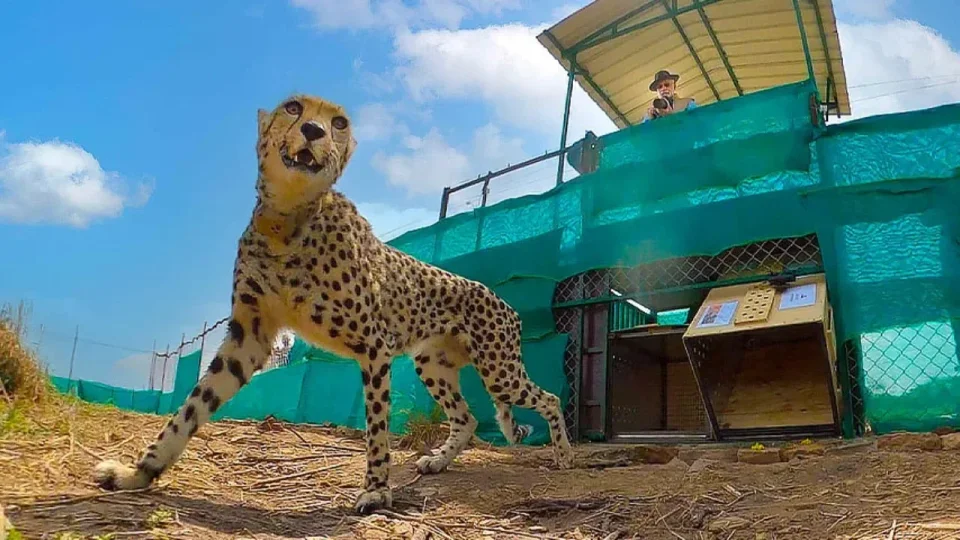
Kuno Cheetah Dies from Gunshot Injuries: A high-level investigation team has been deputed to probe the death of a 19-month-old cheetah at Kuno National Park in Madhya Pradesh, who was found outside the protected area (PA) with five firearm pellets in his body. The incident has sparked concerns among officials over the protection of cheetahs reintroduced under Project Cheetah.
Officials recognised the male cheetah as KNG22. He was found injured on October 25 in the territorial forests of Morena district, which is not the Kuno National Park cover. The KNG22 was rescued the same day from the Sheopur Territorial Forest Division and taken for treatment at a veterinary facility in Jabalpur for veterinary care. However, the cheetah succumbed to his injuries on October 27.
During the surgery, veterinarians recovered all firearm pellets, and subsequently confirmed multiple internal injuries associated with the pellets. The Ministry of Environment, Forest and Climate Change (MoEFCC) said it has taken serious note of the incident, and described it as a matter of utmost gravity, citing the importance of Project Cheetah and the need to protect the reintroduced population.
Also Read: Beyond Tiger Protection: Tackling Human–Wildlife Conflict in Corbett
Centre Forms Team to Investigate Cheetah's Death
The Inspector General of Forests from the National Tiger Conservation Authority (NTCA), the Additional Director of the Wildlife Crime Control Bureau (WCCB) and the Regional Deputy Director of the WCCB have been assigned to the central team to investigate the matter. They will look into the circumstances surrounding the cheetah's death, examine the available evidence and coordinate with the Madhya Pradesh Forest Department to ensure action in the case.
It will also examine existing security protocols and the monitoring and protection measures in place to prevent similar incidents. The team will send an analysis report with recommendations to the Minsitry, which will issue further details to the field authorities as well as the government of Madhya Pradesh. Meanwhile, the state has already constituted a Special Task Force (STF) comprising forest and police officers to investigate the incident. The central team will work alongside the state authorities.
The investigation is important to realise where the loopholes lie in the system. The recovery of firearm pellets establishes that the animal suffered pellet injuries, but the circumstances of the incident and the identity of those responsible remain to be determined.
How Did the Cheetah End Up in Morena's Territorial Forests?
Kuno National Park is primarily located in Sheopur district, while Morena lies to its northeast. The two districts are part of the northern Chambal region of Madhya Pradesh, where protected areas and territorial forest tracts form a wider landscape through which wildlife can move. The cheetah was found in Morena's territorial forests, outside the protected area of Kuno National Park. Its presence there highlights a challenge for wildlife protection: animals do not necessarily remain within the boundaries of a national park.
Cheetahs can cover considerable distances while moving through their habitat. When they move into neighbouring forests and other areas beyond a protected zone, their safety also depends on the monitoring and protection arrangements operating in those landscapes. This makes coordination between forest divisions and law enforcement agencies particularly important. The investigation will need to establish the circumstances in which KNG22 was injured and assess whether existing monitoring and security measures were adequate in the area where it was found.
The incident does not, by itself, establish a wider pattern of security failures. However, it raises questions about how the authorities can protect cheetahs when they move beyond the national park's boundaries.
Also Read: Congress Fails to Bag Any Seat in Karnataka; A Test of Its Electoral Strategies
Why the Death Matters for Project Cheetah
Project Cheetah was launched to reintroduce the species to India after it was declared extinct in the country in 1952. Kuno National Park became the principal site for the programme, which involves establishing a viable population through the introduction of cheetahs from Africa and subsequent breeding. The death of KNG22 comes at a time when India is recording progress in the growth of its cheetah population.
Earlier in October, a 32-month-old Indian-born female cheetah, KJP21, gave birth to five cubs at Kuno National Park. Union Environment Minister Bhupender Yadav announced the development on X, describing it as an important milestone in the emergence of the next generation of India's cheetah population. According to the announcement, the birth took India's total cheetah population to 60, including 41 Indian-born animals. KJP21 became the third Indian-born female cheetah to give birth, after Mukhi and KGP12.
Another historic and joyous milestone for Project Cheetah! 🐆❤️ KJP21, a 32-month-old Indian-born female cheetah, has given birth to five healthy cubs in Kuno National Park today. KJP21 is the third Indian-born female cheetah to give birth, after Mukhi and KGP12—an important milestone in the emergence of the next generation of India’s cheetah population. With the arrival of these five cubs, the cheetah population in India has reached 60, including 41 Indian-born cheetahs. Importantly, these cubs also mark the beginning of the Botswanan lineage in India, as their father is a Botswanan male cheetah—adding a new genetic lineage to India’s growing cheetah population. Another generation born on Indian soil, adding yet another beautiful chapter to the remarkable story of cheetah reintroduction in India. Heartfelt congratulations to the veterinarians, field staff, managers and everyone associated with Project Cheetah, whose dedication, commitment and tireless efforts have made these moments possible. Welcome to the world, little ones 🐆 #WildlifeWeek2026
— Bhupender Yadav (@byadavbjp) October 5, 2026
The birth of the cubs represents progress in the breeding programme, while KNG22's death highlights the challenges involved in protecting the growing population. The two developments underline different aspects of Project Cheetah: the importance of successful reproduction and the need to ensure that animals survive as they move through the landscape. Population growth alone cannot establish the long-term success of a reintroduction programme. Sustained protection, habitat management, veterinary support and effective monitoring are also important.
While India makes a progess with the overall population of Cheetahs, the death of the 19-month-old is a serious setback for the programme. The investigation will determine whether the incident was an isolated act or exposed weaknesses requiring changes to the way India's reintroduced cheetah population is protected.