India Outpaces US in ChatGPT Usage; Sam Altman's Podcast Sparks Fresh Conversation
Sam Altman confirms India has overtaken the US as ChatGPT's biggest market, highlighting growing AI adoption and India's rising influence in the global technology industry.
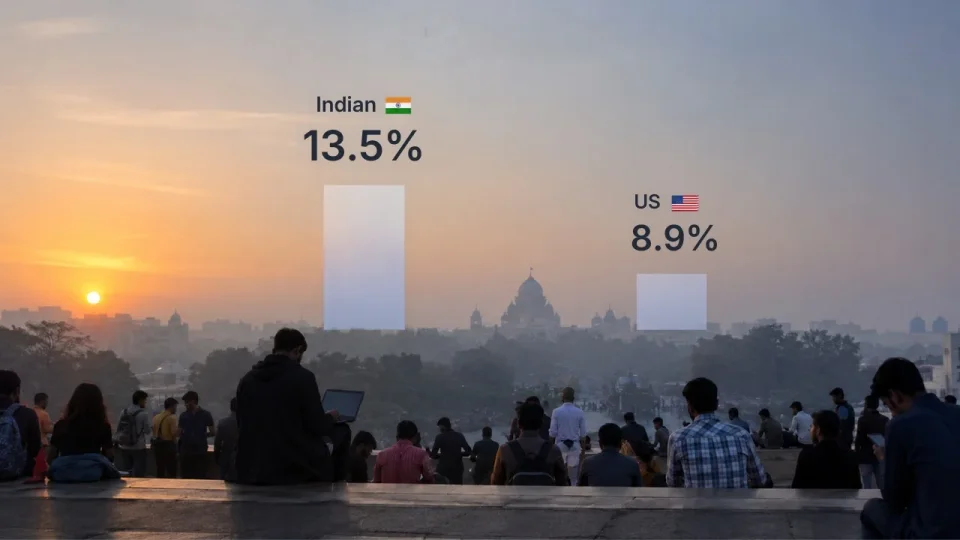
India has overtaken the United States to become ChatGPT’s largest market by user numbers, OpenAI CEO Sam Altman has said, highlighting the country’s growing appetite for artificial intelligence and its expanding role in the global AI economy.
In an interview with Indian podcaster Raj Shamani, Altman pointed to a striking difference in public attitudes towards AI in the two countries. While Americans tend to be more sceptical about the technology, he said, Indian users are considerably more enthusiastic about experimenting with it and exploring its practical applications.
The development marks a significant moment for India's technology sector. As generative AI becomes increasingly integrated into education, businesses, workplaces and everyday life, the scale of India's user base is emerging as an important factor in shaping the technology's future.
But a large consumer market does not automatically translate into technological leadership. India's challenge is to convert its growing adoption of AI into domestic innovation, research capabilities and products that can compete globally.
India’s Growing Lead in ChatGPT Adoption
India's rise as a major ChatGPT market was already visible in the BOND 2025 AI Trends Report, which tracked the global distribution of ChatGPT's mobile app users. In April 2025, India accounted for 13.5% of ChatGPT's global monthly active mobile app users, compared with 8.9% for the United States.
Indonesia followed with 5.7%, while Brazil accounted for 5.4%. Egypt, Mexico, Pakistan, Germany, France and Vietnam also featured among the top 10 markets. The figures highlighted India's importance to OpenAI even before Altman's latest confirmation that the country had surpassed the US in total ChatGPT users.
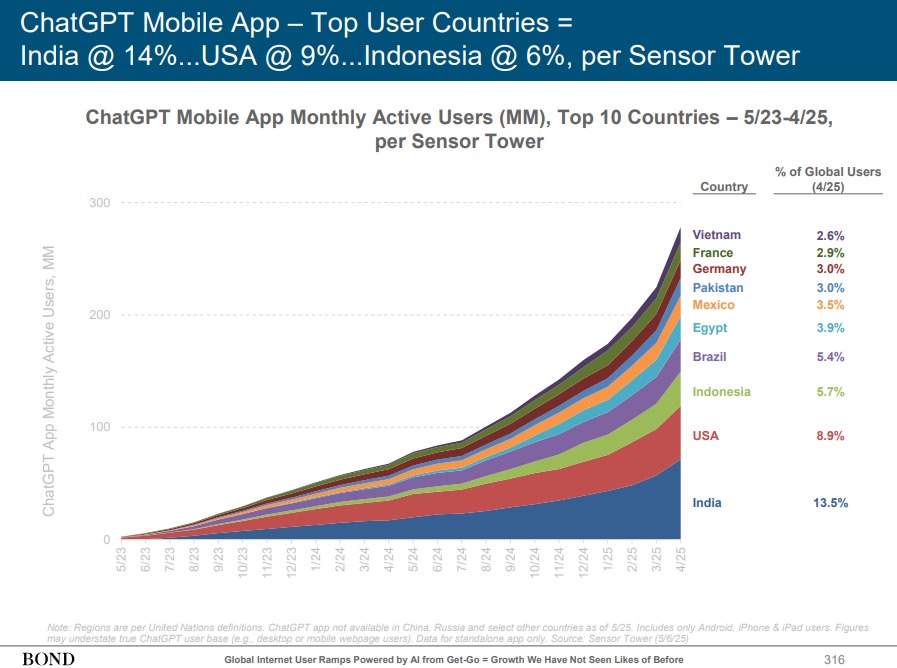
However, the distinction matters. The April 2025 figures represented the share of global monthly active users on ChatGPT's mobile app, rather than the total number of users across its web and mobile platforms. Altman's latest remarks point to a broader shift in the platform's global reach, with India emerging as a central market for the adoption of generative AI.
Sam Altman on India’s AI Optimism
During his conversation with Raj Shamani, Altman discussed how attitudes towards artificial intelligence differ between India and the United States. Shamani observed that conversations about AI in the US are often dominated by concerns about job losses, disruption and the technology's wider consequences. In India, however, the response has been more enthusiastic, with users increasingly interested in experimenting with AI and finding ways to apply it to their work and businesses.
Altman agreed with the observation, describing India's enthusiasm as a significant factor in its growing adoption of the technology. For emerging economies, AI could offer opportunities to improve productivity, develop new businesses and expand access to services. Countries with large populations and growing economies could potentially use the technology to address problems across sectors ranging from education to healthcare and enterprise.
India's enthusiasm, therefore, is not simply about the popularity of a particular chatbot. It reflects the possibility that AI could become an important tool for a population seeking better access to information, services and economic opportunities. Yet optimism alone cannot determine how much a country benefits from the technology. The quality of access, affordability, digital literacy and the ability to develop locally relevant applications will also matter.
Why Is ChatGPT Growing Rapidly in India?
India's growing use of ChatGPT reflects a combination of its large internet audience, expanding digital infrastructure and demand for accessible AI tools.
1. A Large Internet User Base
India's vast internet audience offers AI platforms access to a substantial pool of potential users.
The widespread availability of smartphones and relatively affordable mobile internet has lowered the barriers to accessing digital services. For many users, experimenting with AI does not require specialised hardware or advanced technical knowledge.
This accessibility has helped bring generative AI beyond technology professionals and into the lives of students, workers, entrepreneurs and ordinary internet users.
2. Growing Interest Among Students
Students are increasingly exploring AI tools for academic support, including research, assignment preparation, language learning, exam preparation and explanations of complex subjects.
ChatGPT can help users understand difficult concepts, generate ideas and engage with material in different ways. For students who may not have access to specialised academic support, such tools can offer an additional resource.
However, the growing use of AI in education also raises questions about academic integrity, the reliability of generated information and the extent to which students are developing independent thinking and research skills.
The challenge for educational institutions is to ensure that AI supports learning rather than substitutes for it.
3. Opportunities for Businesses and Startups
AI tools are also attracting interest from Indian businesses and startups looking to automate routine tasks, improve customer service and reduce operational costs.
For smaller businesses, generative AI can provide access to capabilities that would otherwise require specialised teams or substantial investment.
Entrepreneurs can use AI to develop products, analyse information, assist with software development and improve business operations.
The technology could be particularly valuable in a market where businesses are seeking ways to scale while keeping costs under control.
4. Increasing Awareness and Wider Applications
The growing visibility of AI-powered products has also encouraged more people to experiment with the technology.
Applications now extend beyond content generation to software development, data analysis, customer support, translation and research assistance.
As these tools become more accessible, their use is likely to expand across different professions and industries.
However, greater adoption will also require users to understand the limitations of AI systems, including the possibility of inaccurate information, bias and unreliable outputs.
The US Remains a Major AI Powerhouse
India's emergence as ChatGPT's largest market does not mean the United States has lost its position as a leading force in artificial intelligence.
The US remains home to major AI companies, research institutions, technology investors and infrastructure providers. OpenAI, Google, Anthropic and other companies continue to invest heavily in developing advanced AI models and systems.
The country also benefits from access to computing infrastructure, research talent and venture capital, all of which are important to the development of increasingly capable AI technologies.
The distinction between the two markets is therefore significant.
India's growing importance lies in the scale of its adoption and the opportunities presented by its large, expanding digital economy. The US continues to play a central role in developing advanced AI systems and financing the research and infrastructure behind them.
These are not mutually exclusive positions. India's expanding user base could influence how AI products are designed, priced and deployed, while the US remains a major source of the technology itself.
The question is whether India can use its growing market to build a stronger domestic AI ecosystem.
Can India Move Beyond Being an AI Consumer?
India's position as ChatGPT's largest market presents both an opportunity and a challenge for its technology sector.
As AI adoption expands, demand for AI skills, products and services is likely to grow. Businesses may increasingly integrate AI into their operations, while students and professionals use it to improve productivity and develop new capabilities.
But user adoption alone will not determine India's long-term position in the global AI race.
Developing indigenous AI capabilities, expanding computing infrastructure, investing in research and improving access to quality AI education will be crucial.
India will also need to develop AI systems that address its own requirements, including its linguistic diversity, affordability constraints and the needs of its public services and businesses.
The country's large user base could provide valuable opportunities to test and improve locally developed products. However, converting that potential into technological leadership will require sustained investment and a supportive ecosystem for research, entrepreneurship and innovation.
There is also a broader question of technological dependence. If India becomes increasingly reliant on foreign-developed AI platforms without developing sufficient domestic capabilities, its growing adoption could strengthen the position of global technology companies more than its own AI industry.
The challenge is to ensure that the benefits of adoption extend beyond access to products developed elsewhere.
India has now emerged as ChatGPT's largest market by user numbers, according to Altman. The milestone reflects the country's growing enthusiasm for AI and its importance to the technology's global expansion.
But the next stage of India's AI journey will be measured by more than the number of people using ChatGPT.
The real test will be whether India can turn its enormous appetite for AI into homegrown innovation, stronger research capabilities and economic opportunities that extend beyond consumption.