Beyond Tiger Protection: Tackling Human–Wildlife Conflict in Corbett
Corbett Tiger Reserve supports an estimated population of 260 tigers, playing a vital role in tiger conservation across the Terai-Arc landscape. The region is also important for Asian elephant conservation.
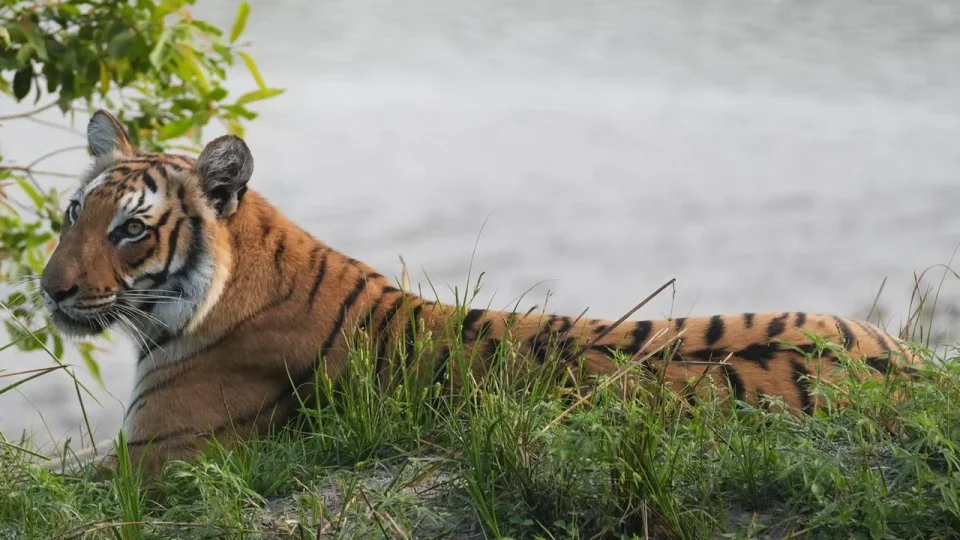
Corbett Tiger Reserve Tiger Population: India is the seventh largest country with a geographical area of 32,87,263 sq km and the most populous country of the world with a population of over 1.4 billion, which is about 17% of the world population. Despite being extremely populous, India stands among the 17 top biodiversity-rich countries of the world and harbours almost 8% of the world’s biodiversity. India supports about 70% of world’s tiger population and 2967 (2603-3346) tigers are reported to be distributed in 18 states of the country.
The Corbett Tiger Reserve (CTR), one of the first nine tiger reserves in the country and the first one to launch project tiger in 1973, together with surrounding forest divisions support an estimated population of about 260 tigers and this population plays an important role in tiger conservation in Terai-Arc landscape. In addition to tiger conservation, Corbett landscape plays very crucial role in the conservation of Asian elephants as the largest concentrations of Northern population of elephants in India is reported from the Rajaji Tiger Reserve and Corbett National Park.
Tiger habitats within these adjacent forest divisions and CTR were contiguous in the recent past but expansion of human habitations, tourism activities, physical construction, and other developmental activities have resulted in excessive pressure and decline in quality of such crucial habitats. Such corridors are critical to ensure genetic and demographic viability of wide ranging tigers, elephants and other wildlife across the entire landscape. Around 17% of the world population is taking a heavy toll on its natural resources currently.
Also Read: US Visas for Indians Plunges Under Trump Despite No Travel Ban
In addition to the population of human beings, India also supports approximately 11% of the world’s livestock, and a majority of these feed on the natural ecosystems, thus depleting them and competing with the wild herbivores. Living close to PAs have both advantages and disadvantages for the local communities.
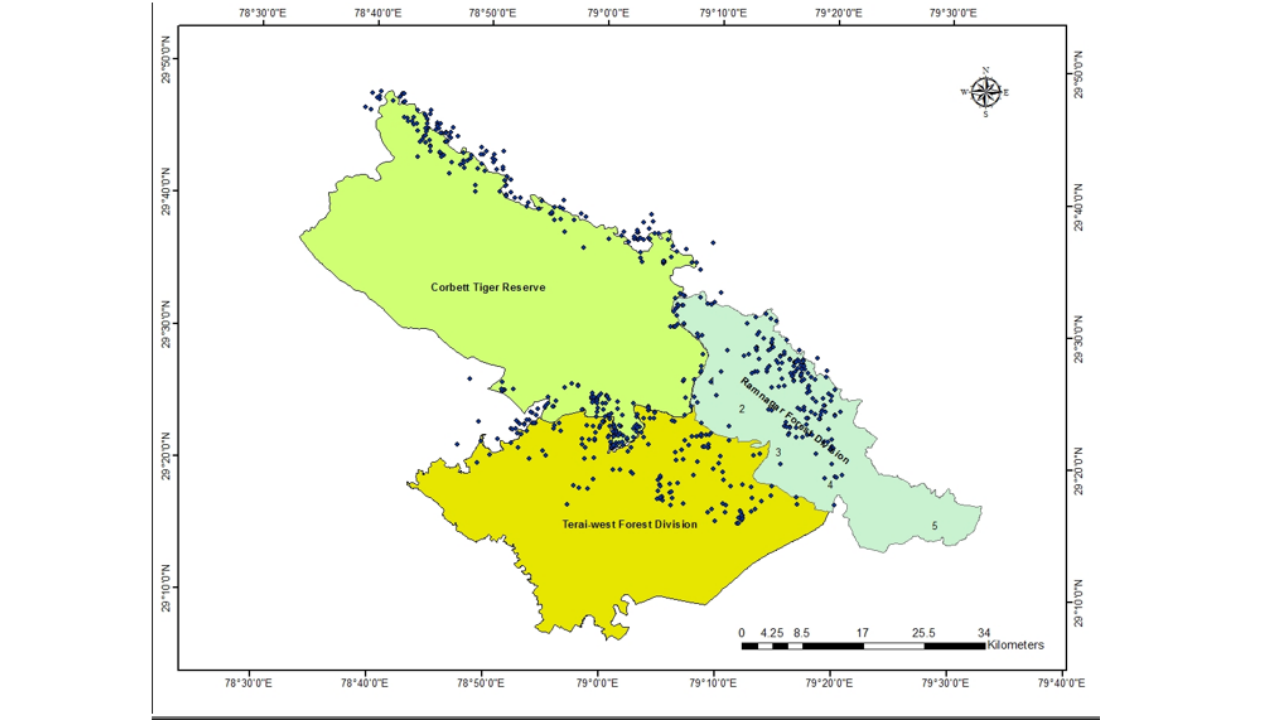
Map showing locations of livestock depredation by the tiger and leopard in and around CTR.
Forest divisions contiguous with the forests of CTR are no exception to it and interspersed with villages, crop fields and developmental activities, roads and townships. In such a scenario issue of Human-Wildlife Conflict (HWC) become inevitable. In North Zone of CTR villages and other human settlements such as Dabru, Kandlai, Khadrasi, Silwad, Bageda, Raishera, Chhimpani, Taidiya, Luthia, and Khuwani, whereas, in South Zone Dhela, BelghattiKhatta, PhantoKhatta, NabigarhKhatta , Patrani, Tera, Sundarkhal, Pattharkunwan, Chukam, and Nabigarh Theeri were found to be the most affected human settlements due to human-wildlife conflict.
In addition, in Ramnagar forest division which serves as crucial corridor in the landscape villages namely Rampur, Patkot, Nathujala, Amotha, Kyari, Saunjhala, Chopra, Chhoi, Okhaldhungaand Mankanthpur were among the topmost affected villages. Crop depredation, livestock killing and human casualties are the main issues locals are suffering the loss from wildlife.
Human-Wildlife conflict (HWC) is an international problem involving most of the carnivore species, elephants, deer, ungulates and other wild species having direct interface with human populations. HWC can be defined as any situation where wild animals use (undesirably) or damage human property; where wild animals harm people; or where people perceive wild animals to be a direct threat to their property or safety. HWC can result in negative attitudes toward wildlife and human retaliation against wild animals, both of which can hamper conservation efforts.
Human vs Animal for Land
Fundamentally, HWC stems from humans and wild animals competing for space and wild animals being attracted to agricultural crops grown by people. On one hand HWC in its various forms can result in economic losses, human injuries and fatalities, and consequent retributions against wild species. On the other hand, majority of the wild animals are protected by national laws and international agreements.
Also Read: Gyanesh Kumar Row: Protest Everywhere Leads to Nowhere
Initiatives that effectively address HWC can reduce the economic burden of wildlife conservation efforts on affected people and create a positive framework for human-wildlife coexistence. Local communities living close to wildlife rich areas and Protected Areas generally endure the primary economic and social burden of conserving wildlife.
Creating protected area for wildlife conservation can undermine the historical rights of local communities, curtail traditional livelihoods, limits role of local communities in managing and protecting such designated areas. Such loss of traditional rights and limiting the role of resident community and other involved stakeholders of a given area often gives rise to social and political mobilisation against tiger conservation. In addition, crop damage, livestock depredation and human casualties by tigers and other wildlife can antagonise local populations.
Mitigation of HWC fundamentally requires balancing conservation goals and needs of locals which can be ensured after having fare understanding of issues impacting local communities living in and around Protected Areas. A number of studies have been conducted on ecological aspects, however, very little empirical research has been done to understand and contextualise the socio-political interactions at site-specific level.
To ensure long term conservation of tigers in Corbett and adjoining forest divisions or any other such landscape, there is a need to review conservation strategies from time to time to balance conservation goals and need of growing human population outside PAs. To ensure long term conservation of tiger by sustaining coexistence with local communities a number of measures have been suggested by the researchers, managers and policy makers, which include maintaining sufficient prey species, inviolate spaces within a given habitat, efficient manpower, protection from poaching and community based conservation approaches.
Even though after having so many studies and years of experience in tiger conservation a practical reconciliation has not been achieved resulting in lack of broadly acceptable approach in tiger conservation. There has been studies supporting possibilities for ‘‘co-existence’’ between tiger and humans and also challenging such possibilities. However, over the years, majority of conservation professionals tend towards involving local communities in conservation plans.
In conclusion, HWC situations are complex and each situation requires careful analysis to address the root causes of HWC by implementing interdisciplinary and science-based management actions involving affected communities. Therefore, there is a pressing need for research that reconciles ecological requirements of tiger and other flagship species with the preferences, priorities and aspirations of local communities to formulate a sustainable landscape-level policy for long term conservation of large carnivores as well as ensuring ecologically safe future to local communities.

Dr. Harendra Singh Bargali is the Deputy Director and Head of Conservation, Policy & Advocacy at The Corbett Foundation (Ramnagar, Uttarakhand). A seasoned conservation biologist, Dr. Bargali leads strategic initiatives aimed at safeguarding critical tiger and Asian elephant corridors across the Terai-Arc landscape. His work focuses on mitigating human-wildlife conflict, community-based stewardship, and advocating for sustainable conservation policies that bridge ecological research with ground-level action.