Centre Allows E100 in Flex-Fuel Vehicles, Raises Weight Cap: Which Vehicles Qualify?
The Ministry permits E100 fuel and increases the light vehicle weight cap to 3,500 kg to accommodate heavier flex-fuel hardware, restricting the pure ethanol fuel to certified FFVs
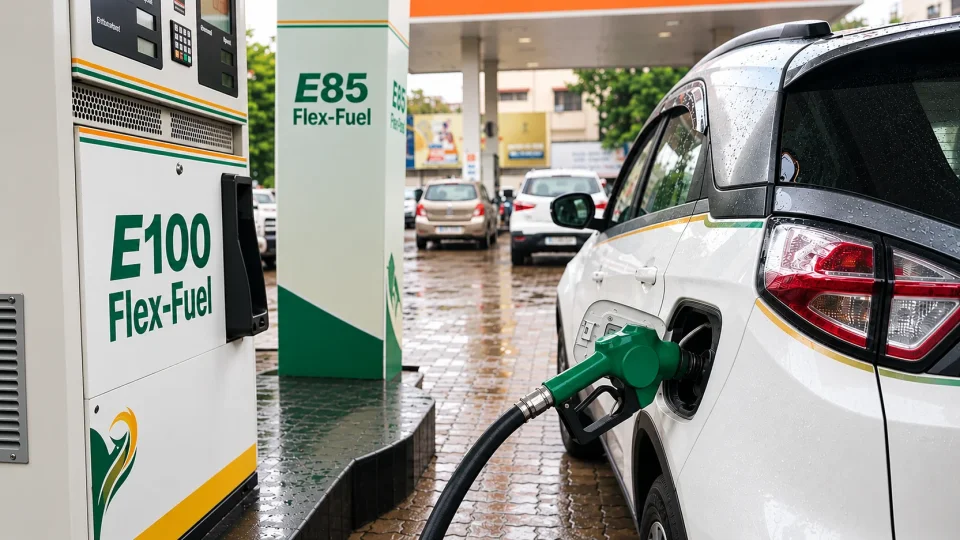
When the Ministry permitted E100 (pure ethanol) fuel, it also raised the maximum weight limit for light petrol and diesel vehicles from 3,000 kg to 3,500 kg. While E100 captured the major headlines, this minor weight increase is crucial to ensuring the practical implementation of the policy.
1. Ethanol Engines Are Physically Heavier
-
Corrosion Resistance: Ethanol is harsher and more corrosive than conventional petrol. To handle E100 safely, vehicles require heavier components, including stainless steel fuel pipes, reinforced composite fuel tanks, and heated fuel injectors.
-
Bigger Fuel Tanks: Ethanol provides lower fuel economy per litre than petrol (approximately 30% less range per unit volume). To prevent drivers from having to refuel constantly, vehicles require significantly larger fuel tanks, which adds extra weight. This 30% mileage reduction depends on various operational factors.
In a prior clarification, the government noted that "mileage depends on driving habits, tyre pressure, servicing frequency, and air-conditioning load far more than fuel type."
Vehicle Eligibility: Which Vehicles Can Run on E100?
No conventional petrol or E20-compliant vehicle currently driven on Indian roads is designed to run on E100.
As confirmed by Ministry of Road Transport and Highways (MoRTH) officials, high-ethanol blends (exceeding E20 up to E100) are restricted exclusively to vehicles specifically manufactured, calibrated, and certified as Flex-Fuel Vehicles (FFVs).
Existing Prototypes and Upcoming OEM Launches
The newly notified rules establish the legal framework required for automakers to homologate and mass-produce E100-compatible models. Several manufacturers have developed prototype models or announced upcoming production vehicles designed for high-blend ethanol:
Manufacturer |
Model / Prototype |
Status & Technical Detail |
|
Maruti Suzuki |
Wagon R Flex Fuel |
First mass-market flex-fuel prototype introduced in India, capable of running on ethanol-petrol blends ranging from E20 to E100. |
|
Toyota |
Innova HyCross Flex-Fuel |
Prototype feature vehicle equipped with an E85/E100-compliant engine paired with a self-charging hybrid powertrain. |
|
Tata Motors |
Punch Flex-Fuel |
Displayed with modified ECU software, ethanol sensors, and upgraded fuel injection systems. |
|
Hyundai |
Creta / Venue Flex-Fuel |
Developed with modified fuel delivery components and calibrated engine management software for higher blends. |
The amendment to the Central Motor Vehicles Rules (CMVR) creates a regulatory structure for E100 and flex-fuel certification. Expanding the gross vehicle weight threshold to 3,500 kg aligns emission testing procedures with international light-duty vehicle (LDV) standards while accommodating the added weight of ethanol-compatible hardware. However, the fuel is intended strictly for dedicated flex-fuel models, and existing on-road petrol or E20 vehicles cannot utilise E85 or E100.
Government Clarifications on Ethanol
Beyond addressing the 30% reduction in fuel economy, the government has responded to several public concerns regarding ethanol. It stated that there is no widespread pattern of engine failures linked to ethanol-blended fuel, as E20 was rolled out only after rigorous safety and endurance testing by automakers and fuel agencies.
Furthermore, vehicle warranties and insurance claims remain fully valid for vehicles using specification-compliant E20 fuel. While critics argue that the government is securing extra profit margins by adopting a cheaper fuel source, rising production costs mean ethanol is no longer significantly cheaper than petrol; the programme continues primarily to secure domestic energy independence and support local agricultural incomes.
The government further noted that viral rumours—suggesting sugarcane juice is directly poured into petrol or that ants swarm fuel caps due to residual sugar—are entirely debunked by industrial distillation processes. Refining completely eliminates sugars and moisture, and modern fuel tanks are engineered with safeguards to exclude water ingress. Additionally, modern ethanol distilleries operate eco-friendly recycling systems that use just 3 to 5 litres of process water per litre of fuel, utilising strictly officially designated surplus grains after national food security requirements are fully met.