Japan Explores India as a Training Ground for Long-Range Missiles
Japan India Missile Training Talks: Japan has sent defence personnel to India to explore the possibility of conducting live-fire training with surface-to-ship missiles and small attack drones. The discussions come as Tokyo seeks overseas training facilities for its expanding long-range weapons, including the Type-25 anti-ship missile.
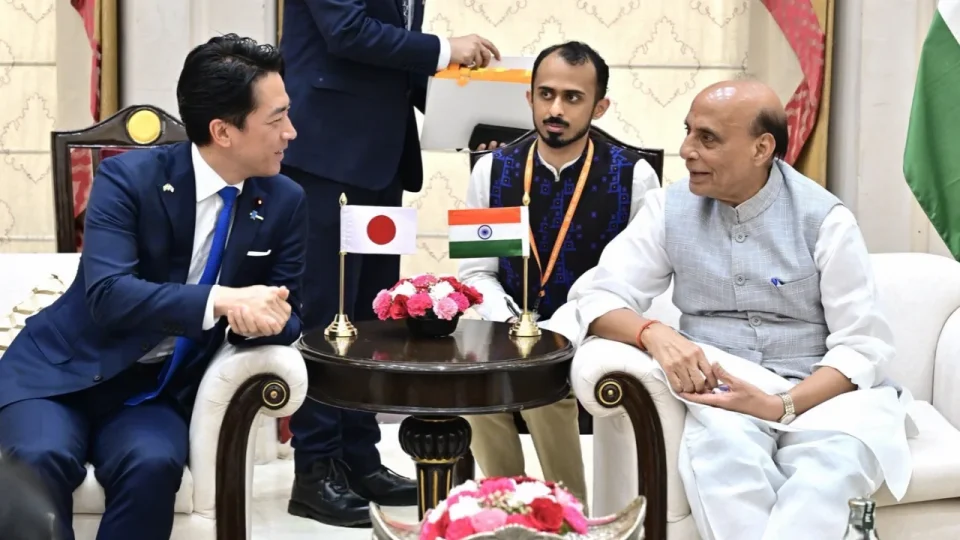
Japan India Missile Training Talks: In a show of strategic partnership, Japan has sent a delegation of defence personnel to New Delhi to explore the possibility of conducting live-fire training with surface-to-ship missiles and small attack drones, as it seeks suitable locations to train with its increasingly long-range weapons. As of now, no decision has been made to conduct the training, and the missile system that could be used has not been selected. However, the discussions highlight a growing challenge for Japan: developing weapons that can strike targets hundreds of kilometres away is only one part of strengthening its military capabilities. Its forces must also find suitable locations to practise using them at their full range.
General Arai Masayoshi, chief of staff of Japan’s Ground Self-Defense Force (GSDF), on October 27 confirmed that personnel had travelled to India to discuss possible arrangements. “When operating relatively long-range missiles, such as surface-to-ship missiles, how to conduct training that makes use of their range is a major challenge,” Arai said, reported The Diplomat.
Japan is examining options within the country as well as overseas facilities that could support such training.
What is Japan’s Type-25 anti-ship missile?
The Type-25 Surface-to-Ship Missile (SSM) is a domestically developed Japanese missile designed to attack targets at sea. Japan named and deployed the missile in March 2026 after completing the development of an upgraded version of its Type-12 surface-to-ship missile. According to Japan’s Defence Ministry, the upgraded Type-12 was developed into a surface-launched variant and officially named the Type-25 SSM. It was deployed to Camp Kengun in Kumamoto Prefecture.
The missile is believed to have a range of around 1,000 kilometres, compared with approximately 200 kilometres for the earlier Type-12 missile. This would allow Japanese forces to engage maritime targets from much greater distances. The Type-25 forms part of Japan’s expanding standoff defence capability. This approach aims to allow Japanese forces to strike an adversary from outside the immediate threat zone of its military units, rather than having to bring their own personnel and equipment closer to hostile forces.
Japan says these capabilities are intended to strengthen deterrence and its ability to respond to threats, particularly amid an increasingly challenging regional security environment.
It is important to distinguish the Type-25 SSM from the Type-25 Hyper Velocity Gliding Projectile (HVGP). Japan announced both systems in March 2026, but they are separate weapons. The Type-25 SSM is a surface-to-ship missile, while the HVGP is a gliding projectile developed for a different role. There is no confirmation that Japan intends to use the Type-25 SSM for any prospective training in India.
Why does Japan Need Overseas Missile Ranges?
Japan’s expanding missile capabilities have created new requirements for military training. Troops need to practise deploying launchers, preparing weapons for firing and operating the systems under realistic conditions. However, training with a missile that can travel around 1,000 kilometres is more complicated than conducting routine drills. Live-fire exercises require sufficiently large and suitable areas, along with arrangements to manage airspace, maritime traffic and public safety.
Japan must also coordinate with local authorities and ensure that exercises do not create unnecessary risks for civilians. These requirements can make it difficult to conduct training that fully uses a missile’s maximum range within Japan. Overseas facilities could provide additional options, although their suitability would depend on the location, the weapon involved and the conditions agreed upon by the countries concerned.
The Type-25’s deployment has therefore increased the importance of finding appropriate training environments. Japan is not simply looking to acquire longer-range weapons; it also needs to develop the personnel and procedures required to use them effectively.
Japan Has Already Conducted Missile Training Overseas
Japan has previously conducted surface-to-ship missile firing exercises in the United States and Australia. It also expanded this activity to the Philippines in 2026. During the Balikatan military exercises held in April and May, the GSDF fired its Type-88 surface-to-ship missile in the Philippines for the first time. The exercise demonstrated Japan’s willingness to conduct missile training beyond its own territory. It also illustrated how overseas military exercises can create opportunities for partner countries to become more familiar with Japanese defence capabilities.
Philippine Defence Secretary Gilberto Teodoro later told The Asahi Shimbun that the Type-88 was among the leading candidates for acquisition by Manila, added the media report. The discussions with India could further expand Japan’s options for overseas training. However, they remain at an exploratory stage, and no specific site, schedule or missile system has been confirmed.
Japan also Eexplores Training with Small Attack Drones
The proposed discussions with India extend beyond missiles to small attack drones. Arai confirmed that Japan was considering whether overseas facilities could be used to train with these systems. He identified several issues that would need to be addressed, including radio frequencies, training activities, operating conditions, suitable locations and safety management. Radio communications are particularly important because drones depend on communication systems to receive instructions and operate effectively. Training must account for how these systems will be used, where they will operate and the conditions under which personnel are expected to deploy them.
Japan is examining both domestic and overseas training options. It has not decided whether overseas exercises would take place before training in Japan or alongside it. The search for suitable locations reflects Japan’s broader effort to strengthen its use of unmanned systems as part of its defence strategy.
What does This Mean for India-Japan Defence Ties?
Japan’s discussions with India come against the backdrop of closer security cooperation between the two countries and growing concerns about China’s military activity in the Indo-Pacific. India and Japan already conduct bilateral military exercises and participate alongside the United States and Australia in the Quadrilateral Security Dialogue, or Quad. Their cooperation takes place amid wider regional concerns over maritime security and the military balance in the Indo-Pacific.
We have posted the highlights from the visit to India on August 19-20🇮🇳 Please take a look! ✨ https://t.co/iZTST7Told
— Japan Ministry of Defense/Self-Defense Forces (@ModJapan_en) August 26, 2026
Arai described India as an important regional partner and stressed the need to promote defence cooperation and exchanges in an increasingly complex security environment. If the two countries eventually agree to use Indian facilities for Japanese missile or drone training, it could add a practical dimension to their defence relationship. It would also provide Japan with another potential overseas option for training with weapons that are difficult to test at their full range domestically.
However, the current discussions concern a possible bilateral arrangement. They do not amount to an announced Quad military exercise, nor do they establish that India has agreed to host Japanese live-fire training. For now, the key question is whether Japan and India can identify suitable facilities and agree on the operational and safety conditions required for such exercises.