Delhi's BS-VI Entry Ban: Why a Valid PUC Certificate May Not Be Enough
Delhi bans non-BS-VI outside vehicles from Nov 1 under GRAP. Valid PUCs might not guarantee entry as border teams deploy database & camera checks.
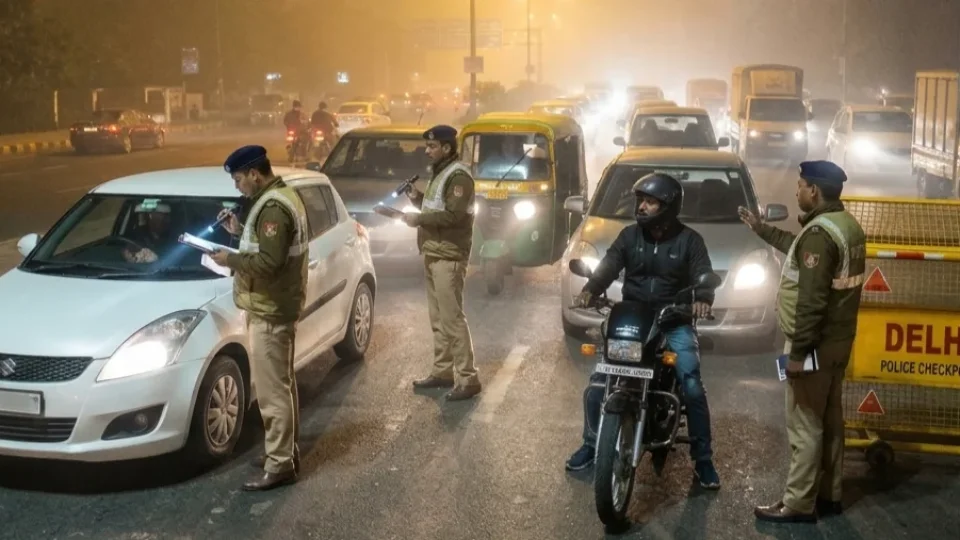
Delhi Pollution Vehicle Check: Delhi on Sunday (November 1) began restricting the entry of petrol and diesel vehicles registered outside the capital that fall below BS-VI emission standards, even if they carry a valid Pollution Under Control Certificate (PUCC), as part of measures to tackle winter pollution. The restrictions highlight a gap between routine PUC tests and the stricter emission standards that determine vehicle eligibility. Gurugram and Noida Police have deployed teams at border checkpoints to prevent violations, while Delhi authorities are using vehicle-database checks and camera-based enforcement. The restrictions are reportedly scheduled to remain in force until January 31, 2027.
The entry restriction does not cover CNG and electric vehicles or vehicles covered by specified exemptions. Delhi-registered vehicles are outside this particular provision, although other applicable pollution-control and vehicle-age rules continue to apply. In its advisory, the Delhi Traffic Police said BS-VI, CNG, electric and exempted vehicles would be allowed, subject to applicable rules, while listing vehicles without valid Pollution Under Control Certificates among those facing restrictions.
From 1 November 2026, vehicle entry into Delhi will be restricted under the revised GRAP rules. ✅ Allowed: BS-VI, CNG, electric and exempted vehicles, subject to applicable rules. ⛔ Restrictions apply to: * Vehicles below BS-VI standards * Vehicles without a valid PUCC * Non-compliant interstate buses * Trucks not destined for Delhi (use peripheral expressways) * Tractors and jugaad vehicles, as applicable * Certain vehicles registered outside Delhi 📅 Check your vehicle’s eligibility before travelling and follow official traffic advisories. 📞 Traffic Helpline: 011-25844444 / 1095 #DTPUpdates #GRAP2026
— Delhi Traffic Police (@dtptraffic) October 29, 2026
The PUC Gap: Does a Certificate Establish Entry Eligibility?
The border crackdown highlights a gap between the emission standard used to decide whether a vehicle can enter Delhi and the pollutants checked during its routine PUC test. BS-IV and BS-VI vehicles face the same PUC limits, even though BS-VI manufacturing standards were designed to deliver substantially lower emissions. A valid PUC certificate, therefore, does not make an otherwise restricted, outside-registered BS-IV petrol or diesel vehicle eligible to enter Delhi.
Under rule 115, the Central Motor Vehicles Rules, 1989, lists identical BS-IV and BS-VI limits for petrol, CNG and LPG cars: carbon monoxide of 0.3% and hydrocarbons of 200 parts per million at idle; carbon monoxide of 0.2% at high idle; and a lambda range of 0.97–1.03. For diesel vehicles, it lists the same smoke light-absorption limit of 1.62 per metre for both standards.
More importantly, the PUC test may not measure nitrogen oxides or particle counts, the pollutants identified as central to the reductions achieved under BS-VI, said HT, citing Rule 115, the Central Motor Vehicles Rules, 1989. The distinction means passing the routine test is not proof that a vehicle’s emissions-control systems are delivering all the benefits expected of its Bharat Stage category.
Border teams to Check Registration Records and Certificates
In Gurugram, special inspection teams have been deployed at Sirhaul toll, Kapashera, Bajghera, Aya Nagar and Gwal Pahari. “Officers stationed at these checkpoints will verify BS-VI emission compliance, registration credentials and valid Pollution Under Control Certificates (PUCC),” Gurugram Traffic Police spokesperson Vikas Soni told The Indian Express. He said roadside inspections would focus primarily on commercial vehicles, interstate buses and heavy goods carriers registered outside Delhi.
In Noida, checks are planned at Chilla border, the Delhi-Noida Direct Flyway, Kalindi Kunj, Pari Chowk and Zero Point, according to the same report. An unidentified Regional Transport Office officer told the newspaper that five transport teams would work alongside traffic police and that registration numbers would be entered into machines to verify emission standards.
For Delhi’s enforcement teams, registration records will be important because officers cannot reliably distinguish every BS-IV vehicle from its BS-VI counterpart by appearance. The Indian Express reported that the Delhi Traffic Police challan application is linked to the Vahan database and that authorities would also use automatic number plate recognition and radio frequency identification technology.
Officials said that camera-based challans would supplement physical checks because personnel could not be stationed at every entry point.
Why The Distinction Matters for Cleaner Vehicles
The environmental case for newer standards extends beyond the pollutants measured at a PUC centre. As per roadside measurements by the TRUE Initiative and analysis by the International Council on Clean Transportation, BS-VI private cars emitted 81% less nitrogen oxide than BS-IV cars, while BS-VI buses emitted nearly 95% less. The study involved about 111,000 exhaust readings collected in Delhi and Gurugram between December 2022 and April 2023, according to the supplied explainer.
Those findings should not be read as a guarantee that every BS-VI vehicle performs equally well. The same report said some BS-VI CNG vehicle categories recorded nitrogen oxide emissions above their laboratory limits.
The policy and testing systems consequently serve different purposes: the entry curb relies on a vehicle’s certified emission category, registration and exemption status, while a PUC certificate records compliance with a narrower set of in-use checks. The identical BS-IV and BS-VI PUC thresholds leave that distinction especially important for motorists approaching Delhi’s borders.
Official Social-Media Advisory
In English:
From 1 November 2026, vehicle entry into Delhi will be restricted under the revised GRAP rules. ✅ Allowed: BS-VI, CNG, electric and exempted vehicles, subject to applicable rules. ⛔ Restrictions apply to: * Vehicles below BS-VI standards * Vehicles without a valid PUCC * Non-compliant interstate buses * Trucks not destined for Delhi (use peripheral expressways) * Tractors and jugaad vehicles, as applicable * Certain vehicles registered outside Delhi 📅 Check your vehicle’s eligibility before travelling and follow official traffic advisories. 📞 Traffic Helpline: 011-25844444 / 1095 #DTPUpdates #GRAP2026
— Delhi Traffic Police (@dtptraffic)
In Hindi:
1 नवंबर 2026 से संशोधित GRAP नियमों के तहत दिल्ली में वाहनों के प्रवेश पर प्रतिबंध लागू होंगे। ✅ अनुमति प्राप्त: BS-VI, CNG, इलेक्ट्रिक एवं छूट प्राप्त वाहन, लागू नियमों के अधीन। ⛔ प्रतिबंध लागू होंगे: * BS-VI से कम मानक वाले वाहन * वैध PUCC के बिना वाहन * नियमों का पालन न करने वाली अंतरराज्यीय बसें * दिल्ली न आने वाले ट्रक (परिधीय एक्सप्रेसवे का उपयोग करें) * लागू नियमों के अनुसार ट्रैक्टर एवं जुगाड़ वाहन * दिल्ली के बाहर पंजीकृत कुछ वाहन 📅 यात्रा से पहले अपने वाहन की पात्रता जाँच लें और आधिकारिक ट्रैफिक एडवाइजरी का पालन करें। 📞 ट्रैफिक हेल्पलाइन नंबर : 011-25844444 / 1095 #DTPUpdates #GRAP2026
— Delhi Traffic Police (@dtptraffic)