Four Train Disasters, Mounting Questions: What Is Going Wrong on Spain’s Railways?
Spain Train Tragedy 2026: 69 killed as high-speed trains collide near Toledo; three days of national mourning begin Thursday
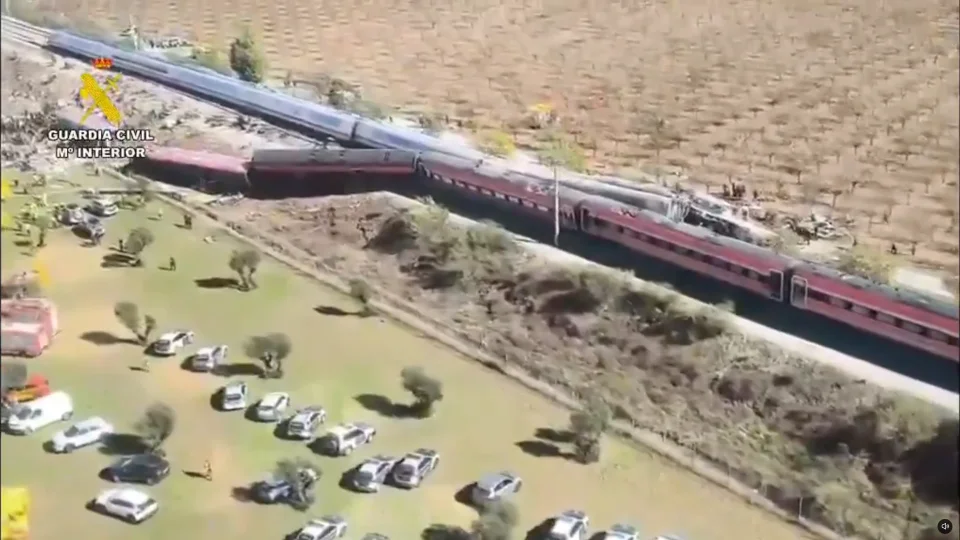
Spain Train Tragedy 2026: A total of 69 people were killed, while more than 100 injured when a high-speed Renfe AVE train rear-ended into a stationary Iryo train near Urda in Spain’s Toledo province on Wednesday, October 28. Those who survived described carriages thrown into chaos, with passengers hurled from their seats and others trapped beneath debris. Spain has declared three days of national mourning, beginning on Thursday. Prime Minister Pedro Sánchez said, “Spain is in mourning,” promised a full investigation and warned that any negligence or safety failure would be addressed with the utmost firmness.
Sánchez, speaking at the scene, said: “All of Spain is in mourning,” and expressed his “full solidarity” with the families of the victims, announcing the activation of the General State Emergency Plan of Civil Protection, mobilizing the UME, the Civil Guard, the National Police, and the entire Civil Protection system.
The collision followed a failure in the LZB train-management safety system, which stopped trains across a stretch of the Madrid–Seville line, after which a controller allegedly authorised the following train to resume at normal speed despite a red signal.
Desplazados más de 300 Guardias Civiles a la zona del #AccidenteFerroviario de Urda para apoyar en labores de auxilio e investigación. https://t.co/tETs5ADHdr
— Guardia Civil (@guardiacivil) October 28, 2026
How the Crash Unfolded
Both trains were travelling from Madrid to Seville when the Renfe-operated AVE struck the rear of the Iryo train standing stationary on the tracks near Urda. The impact derailed carriages and left parts of the wreckage severely damaged, halting high-speed services between Madrid and Andalusia.
Transport Minister Óscar Puente said a computer-system failure affected the LZB safety system along a 63-kilometre stretch of track, causing all trains in the area to stop automatically. Rail infrastructure manager ADIF then took manual command of the system, and a decision was made to allow the high-speed Renfe train to continue southbound despite a red light, said a report by CNN.
According to Puente, the Renfe train was authorised to proceed without speed restrictions because of an erroneous order from a train controller. Between 8:36 a.m. and 8:52 a.m. local time, it resumed travelling at about 124 mph before colliding with the stationary Iryo train. “There was a red signal prohibiting movement, yet the train was authorised to proceed,” Puente said. “It is a decision made under inexplicable circumstances,” the media report added.
Leaked Audio Recording in Focus
Audio recordings between the train controller and driver were leaked to some media outlets, which may serve as preliminary evidence; however, since the investigation is ongoing, these call recordings cannot be judged as final findings.
The driver of the Iryo train had warned the Atocha control centre in Madrid that she was unable to restart her train, several minutes before the collision, said a report by El País (referring to the leaked audio clips). Despite that warning, the controller allegedly instructed the AVE driver to resume “la marcha normal,” normal speed, rather than “marcha a vista”, the slower 40 km/h pace required under safety protocols. The AVE was reportedly estimated to have reached about 200 km/h when it struck the Iryo train.
The recordings also indicate confusion at the beginning of the exchange between the controller and the AVE driver, before ending with a clear order for the train to resume normal operation. According to the government, this violated protocol because controllers had not confirmed that the train ahead had moved far enough away, more than 30 kilometres, to avoid a collision.
Authorities’ Response and Next Steps
Todas las instituciones estamos trabajando día y noche no solo para dar una respuesta a las víctimas y a sus familiares, sino para esclarecer hasta el último detalle de esta tragedia y reforzar la seguridad para que no vuelva a suceder. Desde el primer momento se ha puesto en marcha el Plan General Estatal de Emergencia de Protección Civil, movilizando a la UME, la Guardia Civil, la Policía Nacional y todo el sistema de Protección Civil. Quiero agradecer a todos los servicios de emergencia y de asistencia psicológica su labor en estas horas tan duras.
— Pedro Sánchez (@sanchezcastejon) October 29, 2026
More than 500 emergency personnel were deployed to the crash site, along with at least three helicopters and several drones. Castilla-La Mancha President Emiliano García-Page later said that 1,300 personnel had been mobilised and coordinated in response to the emergency.
Ayer vivimos una catástrofe que produjo un estado de shock en toda España. Quiero volver a hacer un agradecimiento a todas las personas, de los servicios operativos y a título personal, que se han volcado en ayudar. Un dispositivo de 1.300 efectivos movilizados y coordinados, tal y como requería esta situación de emergencia. Y un agradecimiento especial a la ciudadanía. Ayer hubo un récord absoluto de donaciones. De corazón, muchas gracias.
— Emiliano García-Page (@garciapage) October 29, 2026
Rescue crews searched damaged carriages into Wednesday evening under floodlights, while dozens of fire engines, ambulances and police vehicles were sent to the scene. Passengers without serious injuries were moved away by bus; the Civil Guard set up multiple tents as part of the large emergency operation. It further announced the opening of four offices in different Spanish cities to identify victims quickly. The regional government also urgently called for blood donations at sites in Alcázar de San Juan, Ciudad Real and Toledo.
There have been updates from the President, Prime Minister, and the Minister of Transport and Sustainable Mobility. García-Page, in a meeting with the CECOPI emergency coordination body, reviewed the latest information, confirming 69 fatalities in that update, and ‘identification was under way under a strict protocol.’
Acabo de asistir a una nueva reunión del CECOPI en el que todas las administraciones hemos evaluado los últimos datos sobre el grave accidente de alta velocidad de Urda. Lamentablemente, hay confirmados 69 fallecidos y ahora se está trabajando en el proceso de identificación bajo un estricto protocolo. Es una tragedia humana y lo más importante ahora es estar junto a las familias en este proceso tan duro. Lo más positivo, con toda la prudencia, es que somos razonablemente optimistas con la evolución de los heridos.
— Emiliano García-Page (@garciapage) October 29, 2026
Puente said there would be a full investigation into the crash. Sánchez said that if there had been negligence, it would come to light, and that any failures in the safety system would be addressed with the utmost firmness. He also pledged to rebuild trust in Spain’s high-speed rail system.
Survivors’ Accounts
There were 151 passengers on the Iryo train and 393 passengers on the Renfe train, according to the latest update from the regional government of Castilla-La Mancha. Survivors told CNN that the moment of impact was “very chaotic”, with people immediately thrown out of their seats and on top of one another.
One survivor said three train cars were “in terrible shape”. “One was on fire, in another there were people trapped and crying,” the passenger said. “And then in the main one (impacted), there were people buried under debris.” Another passenger, 25-year-old Yoander, said: “I was sleeping, and when I woke up I was already crashing into the seats in front of me.” He said he had hit his face and leg and was in pain, but added that other people needed more help than he did.
Desplazados más de 300 Guardias Civiles a la zona del #AccidenteFerroviario de Urda para apoyar en labores de auxilio e investigación. https://t.co/tETs5ADHdr
— Guardia Civil (@guardiacivil)
A woman travelling on the Renfe train, identified as Patricia, said her train had been stopped for about 20 minutes before an announcement explained there was heavy traffic. “After that, we departed, and maybe not after even three minutes, there was a crash,” she said. “Some people were hurled into the air… it was awful. Some of the train structure got into our carriage, and our carriage wasn’t even the worst (affected),” as reported by CNN.
Evacuated passengers included citizens of several nationalities, including Spain and Brazil. The US State Department said “several” Americans were injured in the collision.
Political Fallout
The crash has put immediate pressure on the government over rail safety, ADIF’s traffic-control procedures and the handling of a high-speed network long regarded as a source of national pride. Sánchez has sought to present the response as one of accountability, saying that negligence would be exposed and that failures would be addressed firmly.
The Spanish trade union CSIF called on Transport Minister Óscar Puente to resign. It said: “We demand that the Government respect the investigation and the presumption of innocence for the head of traffic at ADIF.”
🗣 Exigimos la dimisión de Óscar Puente: pedimos al Gobierno que respete la investigación y la presunción de inocencia para el responsable de circulación de Adif. 🟩 Reclamamos al ministro que asuma sus responsabilidades en vez de utilizar de manera vergonzosa a una persona trabajadora como “chivo expiatorio”. CSIF ya advirtió en septiembre del exceso de horas en las jornadas de trabajo de Adif.
— CSIF Nacional (@CSIFnacional)
Spain’s train drivers’ union, Semaf, said a pre-planned nationwide strike would go ahead on Thursday to demand stronger safety measures. The strike is expected to keep pressure on the government and rail authorities as the investigation continues, added CNN.
Spain’s Series of Rail Crashes this Year
Wednesday’s disaster was the second fatal high-speed rail crash in Spain within this year and the fourth fatal rail incident overall. Until this year, officials said there had been no fatal incidents on Spain’s dedicated high-speed lines since the network opened in 1992, says AP.
Date |
Incident |
Casualties |
|
18 January |
An Iryo train travelling from Málaga to Madrid derailed near Adamuz and collided with an oncoming Renfe train heading to Huelva; preliminary findings indicated a fracture in the rail appeared to predate the derailment. |
46 |
|
20 January |
A commuter train crashed near Gelida, outside Barcelona, after a retaining wall collapsed onto the tracks during heavy rain. |
1 |
|
12 February |
A passenger train travelling from Madrid to Badajoz struck a car at a railway crossing near Talavera de la Reina, in Toledo province. |
1, the car’s driver |
|
28 October |
A Renfe AVE train rear-ended a stationary Iryo train near Urda, in Toledo province, on the Madrid–Seville high-speed line. |
69 confirmed as of now |
Before the Adamuz disaster, Spain’s train drivers’ union Semaf had raised concerns that high speeds were causing vibrations and wear and tear along high-speed railway lines, according to a union source cited by CNN. The successive incidents have raised concerns about Spain’s railway infrastructure, computer systems, and their maintenance.