Why CJP Protest Leaders Rejected the Centre's Initial Offer for Talks
Central government has opened a channel of communication with the Cockroach Janta Party (CJP) ahead of its "Chalo Sansad" march, but the outreach has hit an early hurdle. Protest leaders reportedly rejected offers of talks with administrative officials and a Minister of State, insisting on direct negotiations with either Prime Minister Narendra Modi or a Cabinet minister. By Mahima Katal New Delhi, July 20: The Indian government's decision to reach out to leaders of the Cockroach Janta Party...
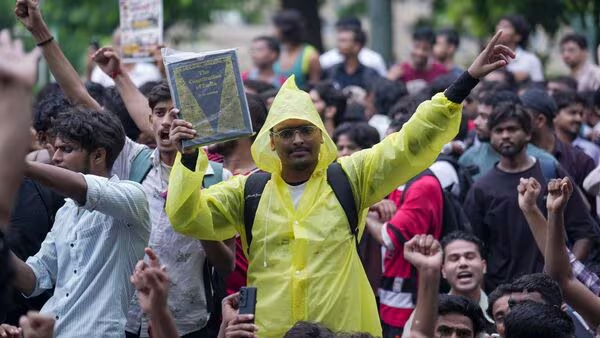
Central government has opened a channel of communication with the Cockroach Janta Party (CJP) ahead of its "Chalo Sansad" march, but the outreach has hit an early hurdle. Protest leaders reportedly rejected offers of talks with administrative officials and a Minister of State, insisting on direct negotiations with either Prime Minister Narendra Modi or a Cabinet minister.
By Mahima Katal New Delhi, July 20: The Indian government's decision to reach out to leaders of the Cockroach Janta Party (CJP) ahead of Monday's "Chalo Sansad" march marked the first significant attempt to open a formal channel of communication with the protest movement.
Cockroach Janata Party (CJP) supporters raise slogans, near Jantar Mantar ahead of a protest march in New Delhi on Monday. Delhi Police is on high alert ahead of the Monsoon Session of Parliament and CJP's proposed Chalo Sansad march.
But instead of paving the way for negotiations, the initiative has shifted attention to a fundamental question: who has the authority to negotiate on behalf of the government when protesters demand political action rather than administrative intervention?
According to sources, New Delhi Deputy Commissioner of Police (DCP) Sachin Sharma has been engaging with the CJP leadership on behalf of the Centre. Before that, the protesters were reportedly offered meetings with a District Magistrate, a Secretary to the Union Government and later a Minister of State. Each proposal was declined.
The CJP has instead sought direct dialogue with either Prime Minister Narendra Modi or a Cabinet minister, submitting a list of preferred ministers through the DCP, according to sources.
The disagreement over representation has become almost as significant as the movement's demands themselves.
More Than a Dispute Over Protocol
At first glance, rejecting an offer of talks might appear counterproductive for a movement seeking government action. But in many democracies, the level at which negotiations take place often determines whether they are viewed as meaningful or merely procedural.
Administrative officials, including District Magistrates, police officers and senior civil servants, play an essential role in maintaining public order, facilitating communication and conveying demands to higher authorities. Their responsibility is to manage the immediate situation on the ground.
However, their authority is limited when protesters seek decisions that require changes in government policy, executive approval or parliamentary action.
From the protesters' perspective, engaging with officials who cannot independently commit the government to policy changes risks reducing negotiations to an information-sharing exercise rather than a process capable of producing tangible outcomes.
Why Governments Begin With Bureaucrats
The Centre's reported approach follows a pattern commonly seen in democratic governments.
Rather than immediately involving senior political leaders, governments typically begin discussions through district administrations or senior bureaucrats. These officials assess the demands, identify areas where compromise may be possible and attempt to reduce tensions before political leadership becomes directly involved.
Such an approach also enables governments to avoid setting precedents in which every organised protest gains immediate access to the highest political offices.
For governments, this gradual escalation preserves institutional processes while ensuring that senior ministers become involved only when necessary.
For protest movements, however, negotiations without political decision-makers can be perceived as lacking credibility.
The current standoff reflects these competing institutional priorities.
Security Overshadows Dialogue
The outreach took place against the backdrop of one of the largest security deployments in central Delhi in recent months.
Authorities closed multiple Delhi Metro stations, imposed extensive traffic restrictions and deployed large numbers of police personnel around Parliament and Jantar Mantar, where thousands of demonstrators assembled.
Eyewitnesses reported that Delhi Police used batons to disperse groups of students and youth activists marching from Mandi House Metro Station towards Jantar Mantar. Sporadic clashes were also reported near the protest site as security forces attempted to regulate access.
Police had not issued a detailed public statement explaining the reported use of force at the time of writing.
The heightened security measures also caused widespread disruption for commuters travelling between Delhi and neighbouring Noida, with long traffic queues forming at several checkpoints.
Sonam Wangchuk Adds Political Pressure
The political significance of the march has been amplified by activist Sonam Wangchuk's prolonged hunger strike.
Earlier on Monday, Wangchuk wrote to the Director of Safdarjung Hospital requesting temporary discharge, stating that his health parameters remained stable and that he wished to join the Parliament march.
He also indicated that he would consider ending his hunger strike if the government accepted responsibility for the issues being raised or if Members of Parliament agreed to formally discuss them.
His continued hospitalisation has generated parallel legal debates concerning patient autonomy, informed consent and the state's responsibility towards individuals engaged in prolonged hunger strikes.
A Democratic Question Beyond One Protest
Although the immediate focus remains on whether talks between the Centre and the CJP materialise, the episode raises broader questions about democratic governance.
Constitutions generally guarantee the right to peaceful protest but rarely require governments to negotiate with demonstrators. Decisions about whether to engage, and at what political level, remain matters of executive discretion.
At the same time, the effectiveness of negotiations often depends on whether those sitting across the table possess the authority to make decisions.
This tension is neither unique to India nor uncommon in democracies. Around the world, governments frequently rely on administrative officials to manage protests, while protest leaders insist on direct engagement with elected representatives capable of delivering political commitments.
The disagreement over representation in Delhi therefore reflects a wider debate about how democratic governments should respond when civic movements seek structural policy changes rather than administrative remedies.
What Happens Next?
Whether the Centre agrees to elevate negotiations to the Cabinet level could shape the next phase of the protest movement.
If meaningful political dialogue begins, it could provide an opportunity to de-escalate tensions that have grown over weeks of demonstrations and hunger strikes. If negotiations remain limited to administrative channels, the deadlock may continue despite the government's initial outreach.
For now, the talks themselves have become a test of governance. The question is no longer simply whether the government is willing to engage with the protesters, but whether it is prepared to place decision-makers at the negotiating table.
That distinction may ultimately determine whether the current confrontation moves towards compromise or further escalation.