What's Really Behind RSS's Gen Z Outreach
RSS reaching for Gen Z visibility right after a leaderless youth movement forced a minister's resignation without needing any institution like it. Whether Bhagwat engages that movement's substance or stays at the level of theme will decide if this is engagement or just calculated proximity. By Mahima Katal New Delhi, Aug 3: Rashtriya Swayamsevak Sangh chief Mohan Bhagwat will address more than 2,000 students aged 15 to 19 from over 100 cities in Mumbai on August 6, in a session framed...
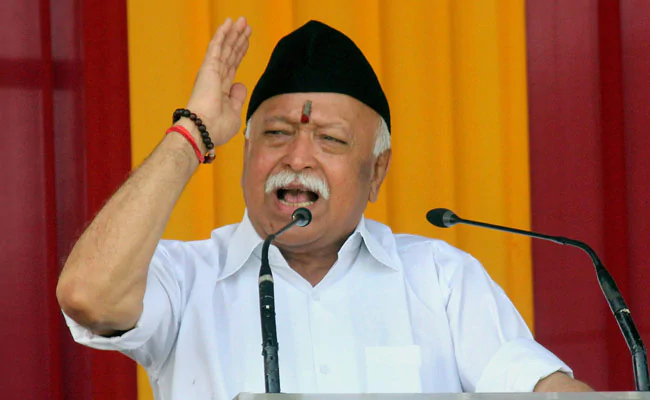
RSS reaching for Gen Z visibility right after a leaderless youth movement forced a minister's resignation without needing any institution like it. Whether Bhagwat engages that movement's substance or stays at the level of theme will decide if this is engagement or just calculated proximity. By Mahima Katal New Delhi, Aug 3: Rashtriya Swayamsevak Sangh chief Mohan Bhagwat will address more than 2,000 students aged 15 to 19 from over 100 cities in Mumbai on August 6, in a session framed around the theme "The Role of Youth in Uniting the World, the Indian Way." Read on its own, the event is unremarkable, an inaugural address at the International Movement to Unite Nations' Annual Championship Conference, marking the organisation's 15th anniversary, hosted at the Nita Mukesh Ambani Cultural Centre. Read against the calendar, it looks considerably less incidental. Bhagwat's appearance comes eleven days after Dharmendra Pradhan resigned as Union education minister, a resignation that followed weeks of youth-led protest under the banner of the Cockroach Janta Party against the NEET examination paper leak, protests that began at Jantar Mantar on June 20 and culminated in a large "Sansad Chalo" march on July 20, days before Pradhan's exit.
The sequence matters because it establishes what kind of political moment this address is walking into. A protest movement organised and sustained by a youth cohort forced a sitting Union minister's resignation within roughly five weeks, a fast, visible demonstration that this generation's political energy does not require conventional party structures, cadre organisations, or institutional gatekeeping to produce consequences. For an organisation like the RSS, built around exactly the kind of hierarchical, cadre-based mobilisation that the CJP protests notably did without, that is not a neutral data point. It is a live illustration of a youth constituency organising and winning without any of the institutional scaffolding the Sangh has spent a century constructing.
That context reframes what the Mumbai address is actually likely to be about. The audience Bhagwat will speak to is not the protest cohort itself, the students in the room are drawn from IIMUN's existing network of debate-society participants across more than 100 cities, an achievement-oriented, invitation-based group rather than the grievance-driven demonstrators who occupied Jantar Mantar through June and July. That distinction is worth holding onto: engaging a curated, already-organised youth audience on themes of leadership and global unity is a materially different exercise from engaging the specific cohort whose spontaneous mobilisation just cost a Cabinet minister his post. The former allows an institution to be seen addressing "youth" as a category while sidestepping the particular grievances, examination integrity, institutional accountability, paper-leak enforcement, that actually drove the more disruptive mobilisation.
Whether the address engages that gap directly or stays within the safer register of unity and leadership is the detail worth watching when Bhagwat actually speaks on August 6. An organisation choosing to be visible among young people at the exact moment a youth protest movement has demonstrated its own independent capacity to force institutional change is making a legible choice, even if the stated occasion is an anniversary conference. What remains to be seen is whether that visibility translates into any acknowledgment of the protest movement's substance, or whether it stays at the level of theme and tone, a distinction that will determine whether this reads, in retrospect, as engagement or as calculated proximity to a moment the RSS did not create and does not control.