The Himalayas Are Becoming More Fragile: What the Poonch-Rajouri Disaster Tells Us About India's Climate Future
Flash floods and landslides in Jammu and Kashmir's Poonch-Rajouri region have claimed lives and displaced families. The tragedy underscores how climate change, fragile Himalayan ecosystems and inadequate disaster preparedness are making mountain disasters deadlier. By Mahima Katal New Delhi, July 19: The flash floods and landslides that tore through Jammu and Kashmir's Poonch and Rajouri districts on Sunday are more than another monsoon tragedy. They are part of a growing pattern that is...
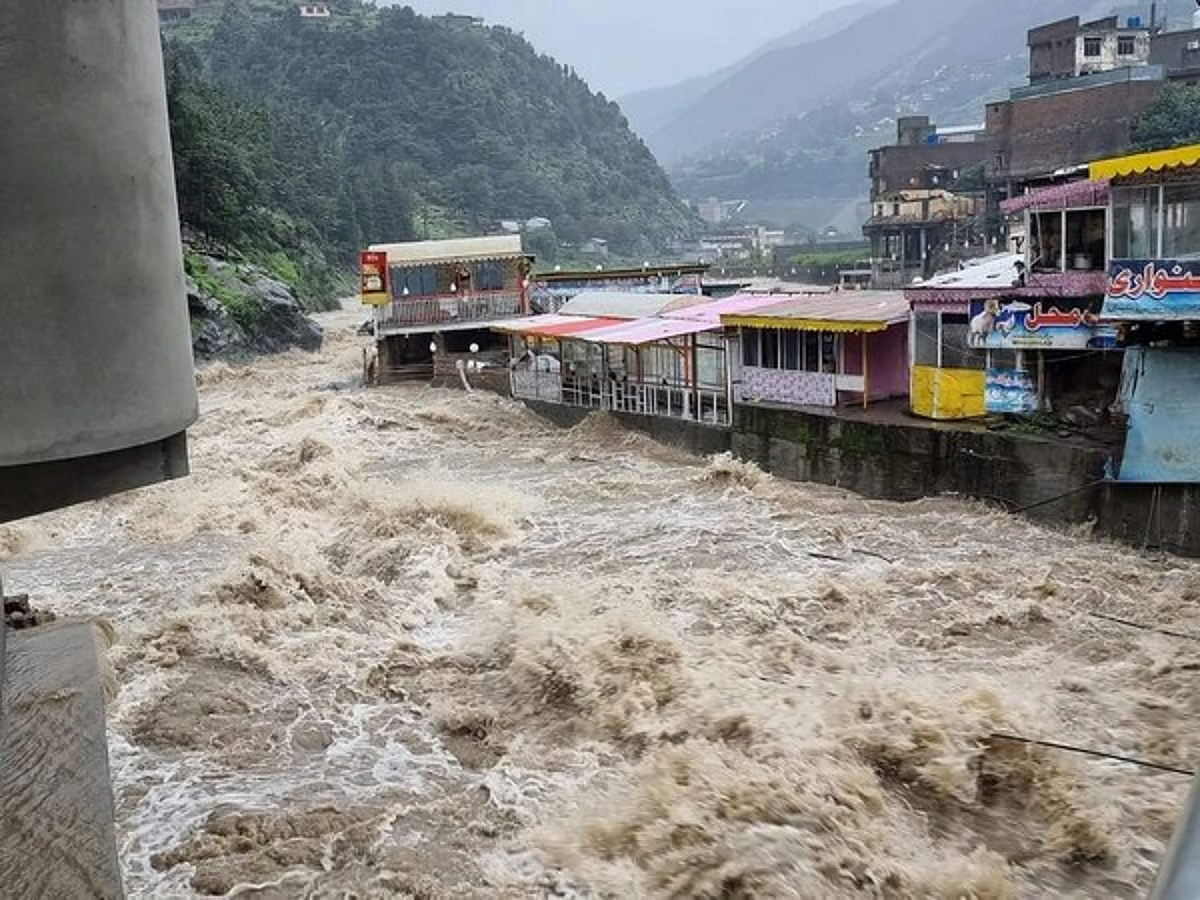
Flash floods and landslides in Jammu and Kashmir's Poonch-Rajouri region have claimed lives and displaced families. The tragedy underscores how climate change, fragile Himalayan ecosystems and inadequate disaster preparedness are making mountain disasters deadlier. By Mahima Katal
New Delhi, July 19: The flash floods and landslides that tore through Jammu and Kashmir's Poonch and Rajouri districts on Sunday are more than another monsoon tragedy. They are part of a growing pattern that is reshaping life across India's Himalayan region.
At least eleven people lost their lives, several remain missing, homes were buried under landslides, rivers overflowed their banks, and entire communities were forced to flee as torrential rain battered the border districts. Rescue teams continue to race against time, but the larger question extends beyond immediate relief: are the Himalayas becoming increasingly vulnerable to disasters that were once considered rare?
The answer is increasingly pointing towards yes.
For decades, scientists have described the Himalayas as one of the world's youngest and most fragile mountain systems. Unlike older mountain ranges, the Himalayas are still rising due to the collision of the Indian and Eurasian tectonic plates. Their steep slopes, loose geological formations and active fault lines naturally make them prone to landslides.
Climate change is now intensifying those natural vulnerabilities.
Across the Himalayan belt, from Kashmir to Himachal Pradesh, Uttarakhand, Sikkim and Arunachal Pradesh, episodes of short-duration, extremely intense rainfall have become more frequent. Instead of steady monsoon showers spread over several days, regions are increasingly witnessing cloudbursts and concentrated rainfall within a few hours. Such rainfall rapidly saturates mountain slopes, weakens soil stability and sends enormous volumes of water rushing downstream, triggering flash floods and landslides.
The devastation witnessed in Poonch and Rajouri fits this increasingly familiar pattern.
The tragedy is also a reminder that disasters in the Himalayas are no longer isolated events.
The 2013 Kedarnath disaster, repeated landslides in Himachal Pradesh over the past few years, the Chamoli glacier disaster in 2021, Sikkim's glacial lake outburst flood in 2023 and multiple flash floods across Jammu and Kashmir all point towards the same reality: mountain hazards are becoming more frequent and more destructive.
Climate change alone, however, does not explain the growing scale of destruction.
Human activity has significantly increased the vulnerability of Himalayan landscapes. Expanding road networks, tunnelling, hydropower construction, deforestation, unplanned urbanisation and hill cutting often destabilise already fragile slopes. While infrastructure development is essential for connectivity and security in border states like Jammu and Kashmir, experts have repeatedly warned that construction in mountain ecosystems must be guided by rigorous geological assessments rather than short-term considerations.
When intense rainfall strikes areas where natural drainage has been altered or slopes have been weakened, the consequences become catastrophic.
The Poonch-Rajouri disaster also raises questions about disaster preparedness.
India has considerably strengthened its disaster response capabilities over the last two decades through institutions such as the National Disaster Management Authority (NDMA), State Disaster Management Authorities (SDMAs), the National Disaster Response Force (NDRF) and improved weather forecasting by the India Meteorological Department (IMD).
Sunday's rescue operations involving multiple agencies demonstrate that emergency response mechanisms are far stronger than they once were. Yet the recurring loss of life suggests that response alone cannot substitute preparedness.
Mountain districts require highly localised early warning systems capable of identifying vulnerable villages, real-time monitoring of rainfall and river levels, evacuation protocols, landslide susceptibility mapping and restrictions on construction in high-risk zones. Equally important is ensuring that local communities receive timely alerts that translate into practical action before disaster strikes.
The legal framework already exists. The Disaster Management Act, 2005, obligates governments to undertake prevention, mitigation, preparedness and capacity building, not merely relief after a disaster has occurred. Disaster governance is therefore measured not only by the speed of rescue operations but also by the effectiveness of risk reduction before extreme weather events.
The increasing frequency of such disasters also has implications for national security. Poonch and Rajouri are strategically important border districts where damaged roads, disrupted communication and repeated natural disasters complicate civilian administration and military logistics. Climate resilience in these regions is therefore not only an environmental concern but also a strategic imperative.
Scientists have long referred to the Himalayas as the "Third Pole" because they contain one of the world's largest reserves of ice outside the Arctic and Antarctic. As glaciers retreat, weather patterns become more erratic and mountain ecosystems grow increasingly unstable, the risks extend far beyond the Himalayan states. Rivers originating in these mountains sustain millions of people across northern India.
The tragedy in Poonch and Rajouri should therefore not be viewed merely as another monsoon casualty report. It is another warning that the Himalayan region is entering an era where climate change, ecological fragility and developmental pressures are converging to produce increasingly severe disasters.
The question is no longer whether such events will recur. The real challenge is whether India's policies, infrastructure planning and disaster preparedness can evolve quickly enough to protect lives in one of the world's most vulnerable mountain ecosystems.