The Hidden Cost of India's 100% Ethanol Target: Water, Land, and Food Crops
India's 100% ethanol push aims to cut its $120-billion crude import bill and secure sugarcane farmers a steadier market, with blending already at 20% by December 2025. But food-versus-fuel land use, sugarcane's water footprint, and older-engine compatibility remain unresolved as the target climbs further. By Mahima Katal New Delhi, July 30: Every litre of petrol sold in India today carries a fifth of its volume as ethanol, fermented from sugarcane, rice, wheat or maize. That share has climbed...
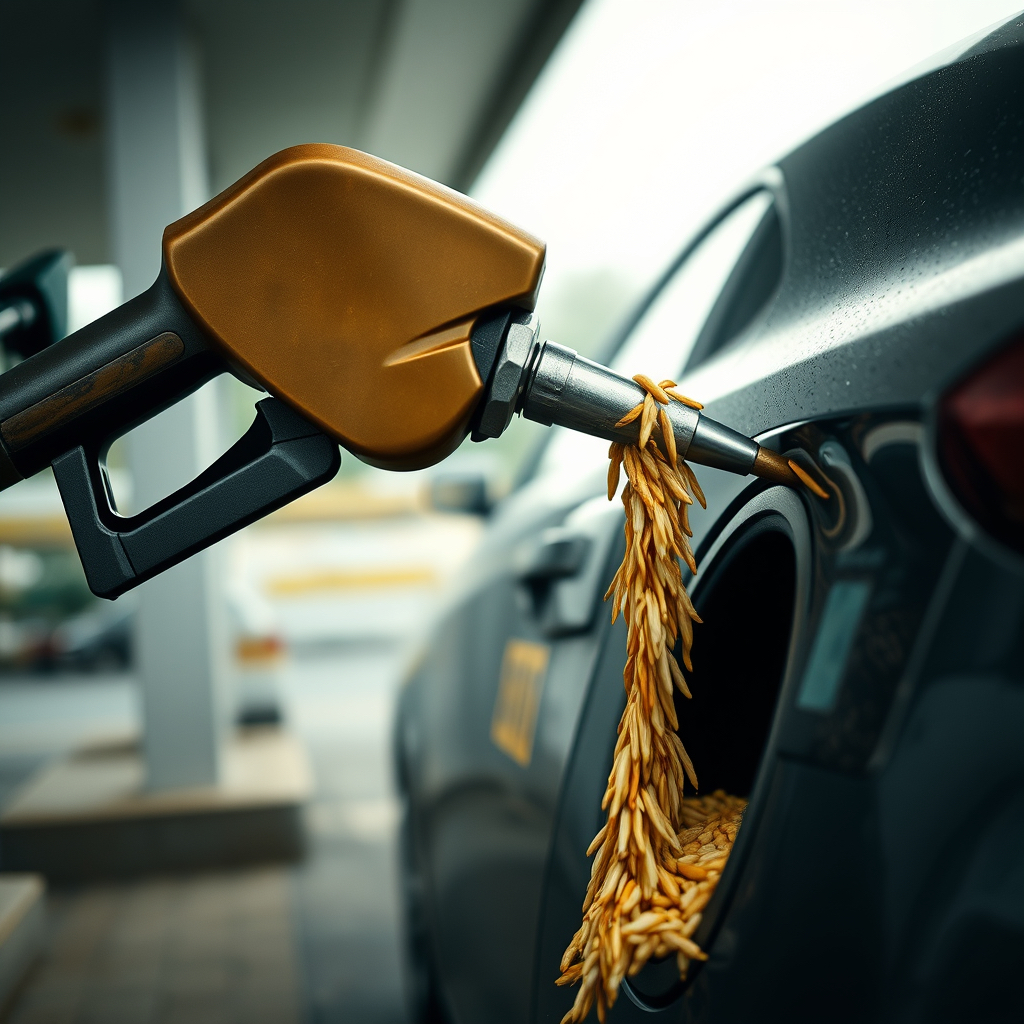
India's 100% ethanol push aims to cut its $120-billion crude import bill and secure sugarcane farmers a steadier market, with blending already at 20% by December 2025. But food-versus-fuel land use, sugarcane's water footprint, and older-engine compatibility remain unresolved as the target climbs further.
By Mahima Katal
New Delhi, July 30: Every litre of petrol sold in India today carries a fifth of its volume as ethanol, fermented from sugarcane, rice, wheat or maize. That share has climbed faster than almost any other target the government has set for itself, and it isn't stopping at 20%. The stated destination is 100% ethanol-blended fuel, reached through intermediate stops at 30% and 85%. The reasons behind that ambition are more layered than the fuel-pump arithmetic suggests, and so are the costs.
The starting point is a number that unsettles economists: roughly $120 billion, what India spends annually importing crude oil, with about 85% of the country's total requirement sourced from the Gulf and Russia. India is the world's third-largest oil consumer, and that dependency transmits directly into the domestic economy whenever crude prices move, a Gulf conflict or an OPEC supply decision inflates the import bill, which pushes up transport and goods costs, which weakens the rupee as dollar demand rises to cover the difference.
Ethanol blending is the government's substitute for a portion of that exposure, replacing imported crude with a fuel grown domestically, with no dependency on a foreign supply chain. The government's own estimate puts the savings from increased ethanol use between 2014 and 2024 at ₹85,000 crores, though a separate official statement has cited a considerably higher figure of ₹1.4 lakh crores.
There is a second constituency behind the push: India's roughly five crore sugarcane farmers, for whom ethanol blending creates an additional buyer in the oil companies, alongside the traditional sugar mills. That agricultural dimension sits alongside the energy-security rationale as a deliberate second objective of the policy, not an incidental byproduct of it.
The pace at which India has moved has been unusual for a policy of this scale. Blending stood at roughly 1.53% in 2013–14, rose to about 8.1% by 2020–21, crossed the 10% mark five months ahead of schedule in 2022, and reached the 20% target, originally set for 2030, then advanced to 2025, by December 2025, according to the ministry's own ethanol-supply-year data. That momentum has fed directly into the case for going further, toward 30%, 85%, and eventually a full transition.
On the vehicle side, the government's position is that the rollout has been backed by extensive validation before each stage of blending. An Inter-Ministerial Committee constituted under NITI Aayog in December 2020 examined vehicle compatibility and mileage impact, drawing on research from Indian Oil Corporation, the Automotive Research Association of India and the Society of Indian Automobile Manufacturers, and its 2021 roadmap covered material compatibility, engine calibration and durability ahead of the E20 rollout. A joint study by IOCL, the Indian Institute of Petroleum Dehradun, SIAM and ARAI found that E20 vehicles continued to meet applicable emission norms and that legacy vehicles showed no abnormal wear, with the one caveat concerning certain BS-III vehicles manufactured before 2016, where some rubber components may need replacement during routine servicing.
In a Rajya Sabha answer given on 29 July 2026, in response to a question on E20's impact on vehicle performance, the Road Transport and Highways Ministry went further, stating that no widespread issues of engine failure or breakdown attributable to blending have been reported to it, and that the concerns in circulation have arisen largely through public commentary and social media discourse rather than through documented complaints.
That confidence, however, sits against a set of trade-offs that grow more difficult to manage as the blend percentage rises. Ethanol production competes directly with food production for land and water. Kharif sowing data for 2025–26 shows maize acreage up 10.5% year-on-year and sugarcane acreage rising as well, gains that have come substantially at the expense of pulses and oilseeds, a substitution that risks deepening India's reliance on imported staples and edible oils even as it reduces reliance on imported crude. The government has directed that only damaged foodgrain and surplus sugarcane be diverted to ethanol, not food-grade crops, but that boundary has proven difficult to enforce whenever ethanol procurement prices run ahead of sugar prices, as briefly occurred in 2023 when a weak harvest forced mills to halt diversion altogether.
Water is a second constraint. Sugarcane, which accounts for roughly 30–35% of India's ethanol feedstock, requires about 3,000 litres of water for every litre of ethanol produced, a ratio that carries real weight in a country already under acute water stress. A NITI Aayog assessment has attributed a substantial share of Uttar Pradesh's water pollution to unsustainable sugarcane cultivation and untreated mill effluent discharged into rivers. Land-use pressure compounds both problems: expanding cultivation for biofuel feedstocks risks encroaching on forest cover, which would work against the very climate case ethanol is meant to serve.
The engine-compatibility question, while smaller in scale, is not fully closed either. Ethanol is mildly corrosive to rubber seals, fuel lines and certain plastics in older engines not designed for higher blends, and while the government's studies report negligible average effects, a 2014–15 ARAI-IIP-IOCL study did find a fuel-economy drop of up to 6% in some vehicle categories under E20, alongside inferior elastomer performance. How the public receives these findings may matter as much as the findings themselves, research cited in international reporting has found that perceived unfairness in how a policy's costs are distributed erodes public trust in it more than either its cost or its practical effectiveness, a dynamic likely to intensify as blending moves toward 30% and beyond, and a larger share of India's vehicle fleet and agricultural land is drawn into the transition.
India's ethanol push, then, is best understood as a bet with two well-defined payoffs, reduced import dependency and a steadier market for millions of farmers, set against three underdeveloped ledgers: food security, water stress and vehicle compatibility, each of which grows heavier as the blend ratio climbs from a fifth of every tank toward all of it.