Supreme Court Signals Preference for Independent Investigation Over Local Police in Ram Temple Donation Case
The Supreme Court has asked the Uttar Pradesh government to consider whether the SIT that initially examined the alleged Ram Temple donation embezzlement can conduct the investigation instead of the local police. Emphasising fairness and transparency, the Court also cautioned against politicising the case, highlighting broader questions of accountability in institutions that receive public donations. By Mahima Katal New Delhi, July 20: The Supreme Court on Monday indicated that an...
The Supreme Court has asked the Uttar Pradesh government to consider whether the SIT that initially examined the alleged Ram Temple donation embezzlement can conduct the investigation instead of the local police. Emphasising fairness and transparency, the Court also cautioned against politicising the case, highlighting broader questions of accountability in institutions that receive public donations. By Mahima Katal
New Delhi, July 20: The Supreme Court on Monday indicated that an independent investigation may inspire greater public confidence in the alleged misappropriation of donations at the Ram Temple in Ayodhya, asking the Uttar Pradesh government whether the Special Investigation Team (SIT) that initially examined the matter could be entrusted with the probe instead of the local police.
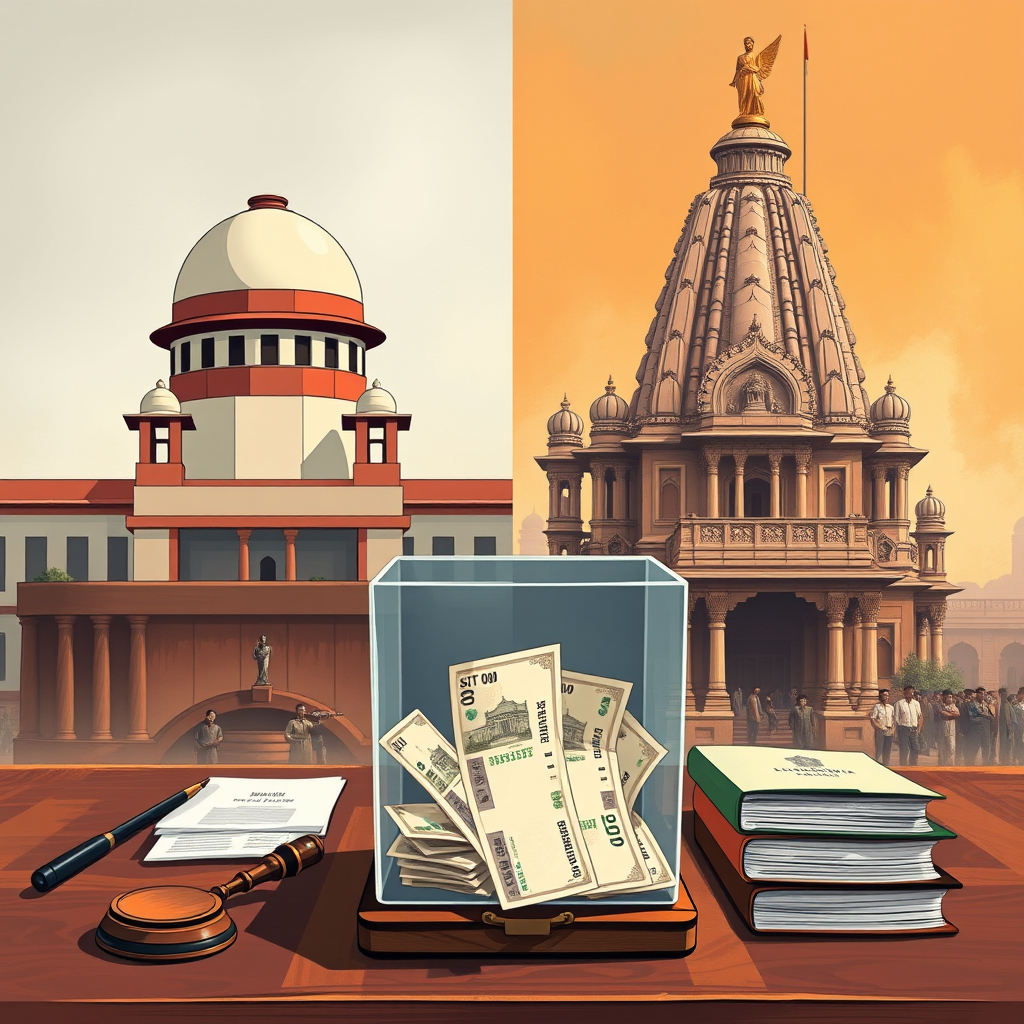
AI Generated Image.
While stopping short of transferring the investigation, the Court's observations underscored a broader principle: in cases involving institutions of immense public faith and significant financial contributions, the credibility of the investigative process can be as important as its outcome.
A Bench comprising Chief Justice of India Surya Kant and Justices Joymalya Bagchi and V. Mohana asked Solicitor General Tushar Mehta, appearing for the Uttar Pradesh government, to seek instructions on whether the SIT could take over the investigation after it had already concluded that a cognisable offence appeared to have been committed.
The Court also cautioned all parties against turning the proceedings into a political contest.
"Please don't politicise the issue. The courts are not a place for politics. It is a simple case of commission of crime. We are here just to ensure a proper investigation," the Chief Justice observed.
Court Questions Why Local Police Is Investigating
During the hearing, the Uttar Pradesh government informed the Bench that an SIT had been constituted earlier to verify the allegations, following which an FIR was registered and the investigation was handed over to the local police.
The Court questioned whether the same SIT, comprising senior administrative and police officers, could instead conduct the criminal investigation to ensure fairness and transparency.
According to the state, the SIT consisted of two senior IAS officers and the Inspector General of Police, Lucknow. The Bench noted that such a high-level panel might command greater public confidence than an investigation by the local police.
Solicitor General Tushar Mehta informed the Court that eight persons had already been arrested and that the investigation was progressing, though he declined to disclose further details because of the ongoing probe.
The matter has now been listed for further hearing next week.
Why the SIT Question Matters
The Supreme Court's suggestion goes beyond this individual case and reflects a recurring judicial concern in sensitive investigations.
An SIT is typically constituted when allegations involve significant public interest, require specialised expertise, or demand a level of independence beyond routine policing. Unlike a standard police investigation, an SIT usually consists of senior officers drawn from different departments and is expected to function with greater institutional autonomy.
By asking whether the existing SIT could undertake the investigation, the Court appeared focused on strengthening public confidence rather than expressing dissatisfaction with the investigation conducted so far.
Importantly, the Court did not order a CBI investigation, despite several petitions seeking one.
Transparency in Religious Donations Also Comes Under Focus
Apart from the criminal investigation, the hearing also brought attention to the transparency of donations made by devotees.
Senior advocate Devadatt Kamat, appearing for one of the petitioners, submitted that records of donations collected during the temple's construction should be preserved and uploaded to ensure transparency.
The Bench indicated that it would examine this aspect separately and consider issuing directions during the next hearing.
If pursued further, the issue could raise broader questions about financial accountability and disclosure norms for religious trusts that receive substantial public donations.
Multiple Petitions Seek Independent Probe
The Supreme Court is hearing multiple petitions seeking an independent investigation into the alleged embezzlement of donations received by the Shri Ram Janmabhoomi Teerth Kshetra Trust.
The petitions seek varying reliefs, including:
A court-monitored CBI investigation;
A forensic audit of the Trust's finances;
An audit by the Comptroller and Auditor General (CAG); and
Greater transparency in maintaining and publishing donation records.
The Uttar Pradesh government had constituted the three-member SIT on June 13 following complaints received from the Trust itself regarding alleged financial irregularities.
After the SIT reportedly found the allegations disclosed a cognisable offence, an FIR was registered and the investigation was transferred to the local police.
A Larger Question of Public Confidence
The Supreme Court's observations indicate that the case is no longer confined to allegations of theft alone. It now raises broader questions about how investigations involving institutions of deep religious significance should be conducted.
The Court's emphasis on avoiding political rhetoric while ensuring an impartial investigation reflects an attempt to protect both the integrity of the criminal justice process and public confidence in institutions that receive donations from millions of devotees.
The next hearing is expected to determine whether the investigation will continue with the local police or be entrusted to the SIT, a decision that could shape the course of the case and set an important precedent for handling allegations involving major public and religious institutions.