Mamdani's Indian Identity Is the Shield. Hindu Nationalism Is the Target.
By Mahima Katal Mamdani's objection to Bhagwat's NYC event extends a years-long record, from 2020 Ayodhya protests to calling Modi a "war criminal", of confronting Hindu nationalist politics directly. New Delhi, Aug 26: New York City Mayor Zohran Mamdani said this week that he does not support an upcoming Madison Square Garden address by Mohan Bhagwat, chief of the Rashtriya Swayamsevak Sangh (RSS), India's largest Hindu nationalist organisation. He also acknowledged, in the same breath,...
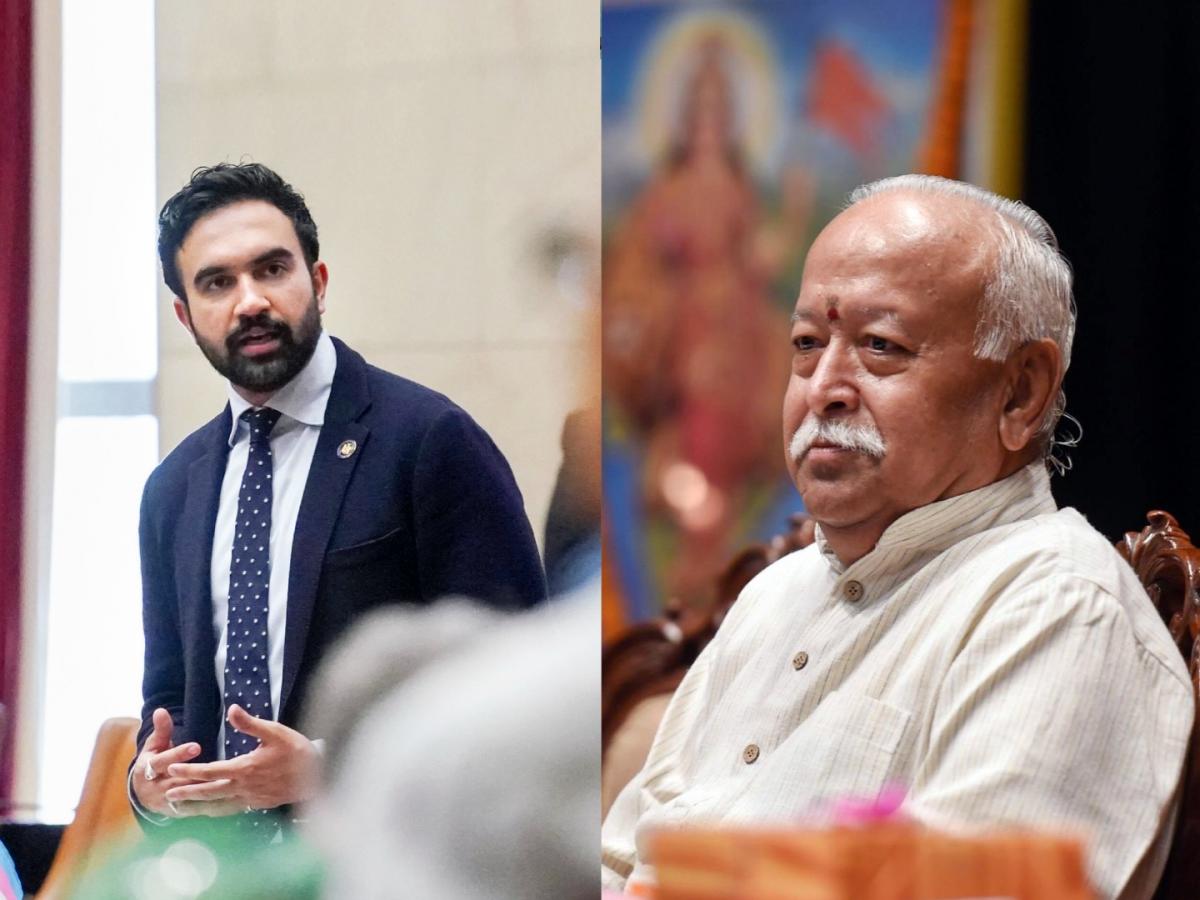
By Mahima Katal Mamdani's objection to Bhagwat's NYC event extends a years-long record, from 2020 Ayodhya protests to calling Modi a "war criminal", of confronting Hindu nationalist politics directly.
New Delhi, Aug 26: New York City Mayor Zohran Mamdani said this week that he does not support an upcoming Madison Square Garden address by Mohan Bhagwat, chief of the Rashtriya Swayamsevak Sangh (RSS), India's largest Hindu nationalist organisation. He also acknowledged, in the same breath, that the city has no real power to stop it. The event is a private booking. Mamdani's objection changes nothing about whether it happens on August 29.
That combination, a strong personal statement paired with an admission of no jurisdiction, is worth sitting with, because it tells you what kind of intervention this actually is. It is not governance. It is positioning. And the position Mamdani chose to take says as much about how he wields his own identity as it does about what he thinks of the RSS.
What he said, and how he said it
Speaking to reporters, Mamdani called the RSS part of "the rise of a movement... predicated on an exclusionary vision of any country" and said he opposes it "not only as an Indian American, but also as the mayor of a city that believes deeply in the belonging of each and every person." He invoked his mother's family, still in India, and his position as the first Indian-American mayor in the city's history.
Notice the structure of that sentence. He does not oppose the RSS merely as a mayor overseeing a diverse constituency, a role that would be defensible on civic-pluralism grounds alone. He opposes it as an Indian American first. That framing does specific work: it pre-empts the obvious rebuttal, that a non-Hindu, non-Indian politician has no standing to weigh in on an internal diaspora cultural event, by claiming insider authority before anyone can raise the objection.
It is a shield. And like most shields, it is also a weapon: once his Indian identity is established as the basis for speaking, anyone who disagrees with him is implicitly arguing with an authenticity claim, not just a policy position.
This is not new
Mamdani's relationship with Hindu nationalist politics did not begin this week. In 2020, he was reported at a Times Square protest against the construction of the Ram Mandir in Ayodhya. He has repeatedly described New York State Assemblywoman Jenifer Rajkumar, the first Hindu American elected to that body, as aligned with "Hindu fascists" and called on her to return donations he characterised as coming from that constituency. In May, at a mayoral forum, he described Indian Prime Minister Narendra Modi as a "war criminal" over the 2002 Gujarat riots, drawing an explicit comparison to Benjamin Netanyahu.
Each of these episodes follows the same pattern as his Bhagwat comments: a targeted claim about Hindu nationalist politics or figures, delivered with reference to his own Indian or Gujarati Muslim background as the credential that entitles him to make it.
Where the target gets blurry
The RSS is a real, documented organisation with a real ideological project, Hindutva, or Hindu majoritarian nationalism, and a history that includes being banned in India three times, most recently after Mahatma Gandhi's assassination by a former RSS member (the organisation itself denied institutional responsibility and was later cleared of complicity in that case). Criticising it is not, on its face, criticising Hindus or Indians.
But Mamdani's own language does not always hold that line as cleanly as his defenders suggest. Bhagwat is not addressing a party convention; he is addressing roughly 5,000 members of the Indian diaspora at what organisers are calling a "Universal Oneness" programme, part of RSS's global outreach in its centenary year. When Mamdani frames that gathering in civilisational terms, a movement's "exclusionary vision," set against a city that believes in "the belonging of each and every person", he is casting the audience, not just the ideology, as the thing in tension with pluralism. That is where his critics' complaint has real purchase: the rhetorical distance between "I oppose RSS's political project" and "I oppose this gathering of Indian-Americans" collapses faster in his phrasing than in his stated intent.
The reaction is doing its own work
Hindu American groups and commentators have called Mamdani's stance "Hinduphobic," pointed to his mixed heritage, his mother, filmmaker Mira Nair, and his father, Gujarati-origin academic Mahmood Mamdani, and, in some cases, questioned his name and identity outright. Separately, interfaith and civil rights organisations held their own press conference opposing the Bhagwat event, on different grounds tied to RSS's record rather than diaspora identity.
That second group matters, because it complicates the "Mamdani versus the diaspora" framing his critics favour. He is not a lone objector; he is one voice inside a broader coalition that includes Muslim, South Asian progressive and interfaith constituencies who oppose the event for reasons that don't route through his personal biography at all. Whether his identity-first framing helps or hurts that coalition's actual argument is arguably the more interesting question than whether he was right to object at all.
The bottom line
Mamdani's opposition to the Bhagwat event is not a departure. It is the clearest recent instance of a pattern he has run for years: oppose Hindu nationalist politics, credential the opposition through his own Indian identity, and let that credential do the work of deflecting the charge that he's attacking a community rather than an ideology. Supporters read that as an insider's principled stand against majoritarianism. Critics read it as a shield that lets him say things about Hindu institutions he could not say as credibly from outside them. Both readings can be true at once, and the gap between them is exactly why this story keeps recurring.