India Ranks 176th in the 2026 Environment Performance Index. But Does the Ranking Tell the Whole Story?
India has ranked 176th out of 177 countries in the 2026 Environment Performance Index (EPI), reigniting debate over the country's environmental record and the methodology behind global sustainability rankings. While the index points to severe shortcomings in air quality, ecosystem protection and climate policy, New Delhi has consistently questioned its scientific basis. The controversy raises a broader policy question: how should developing economies be assessed in an era where climate...
India has ranked 176th out of 177 countries in the 2026 Environment Performance Index (EPI), reigniting debate over the country's environmental record and the methodology behind global sustainability rankings. While the index points to severe shortcomings in air quality, ecosystem protection and climate policy, New Delhi has consistently questioned its scientific basis. The controversy raises a broader policy question: how should developing economies be assessed in an era where climate responsibility, historical emissions and developmental needs increasingly collide? By Mahima Katal
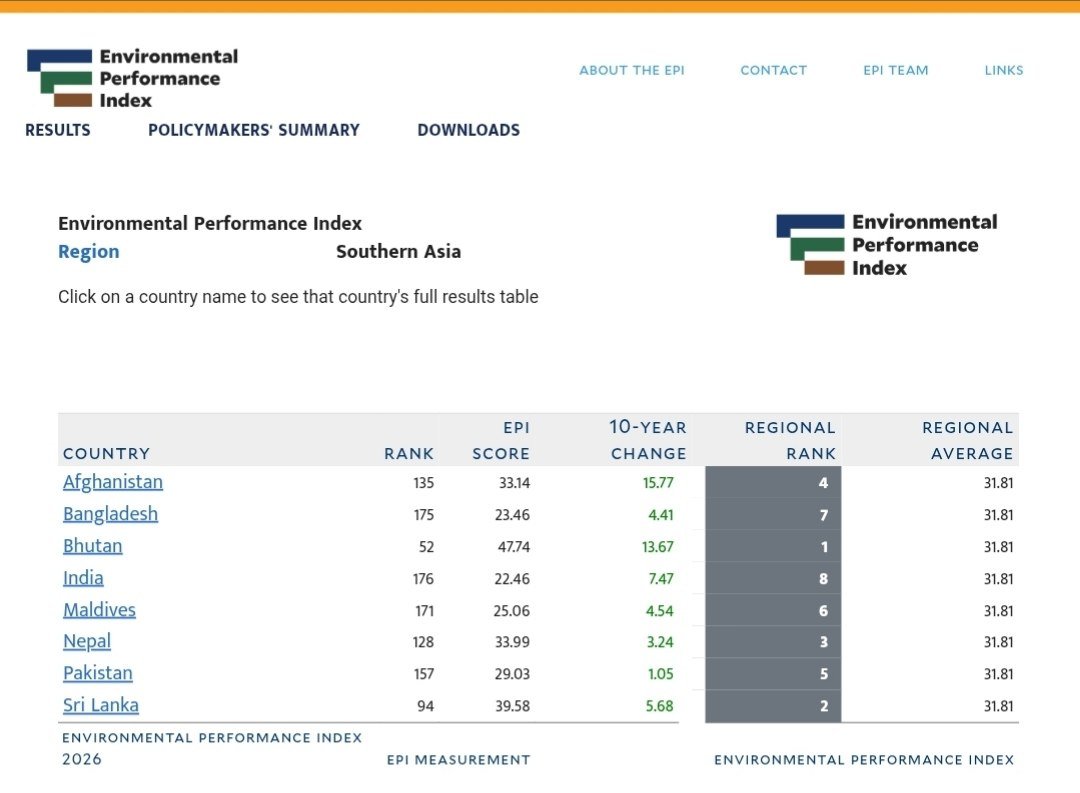
New Delhi, July 13: India has been placed 176th among 177 countries in the 2026 Environment Performance Index (EPI), making it the lowest-ranked country in South Asia and one of the poorest performers globally.
With a score of 22.4 out of 100, India trails not only developed economies but also neighbours including Bhutan, Sri Lanka, Nepal, Bangladesh, Pakistan, Afghanistan and the Maldives. Estonia topped the rankings with a score of 74.79.
The findings have revived a familiar debate: does India's low ranking accurately reflect its environmental performance, or does the methodology fail to account for the realities of developing economies?
The answer lies somewhere in between.
What Is the Environment Performance Index?
The Environment Performance Index is a biennial global assessment developed by researchers from Yale University, Columbia University, and collaborating institutions.
Rather than measuring environmental ambition or policy announcements, the EPI evaluates actual environmental outcomes using internationally available datasets.
The 2026 edition assessed 177 countries across 47 indicators, grouped under three broad policy objectives:
Environmental Health
Ecosystem Vitality
Climate Change Mitigation
These indicators include air pollution, drinking water, sanitation, biodiversity, forests, fisheries, greenhouse gas emissions and renewable energy performance.
Countries receive scores on a scale of 0 to 100, with higher scores indicating stronger environmental performance.
Unlike many governance indices, the EPI is outcome-based. Governments are assessed on measurable environmental conditions rather than policy intent.
Why Did India Rank So Low?
India performed poorly across nearly every major category.
It ranked:
174th in Environmental Health
171st in Ecosystem Vitality
130th in Climate Change Mitigation
The report attributes India's weak performance primarily to:
severe urban air pollution,
continued dependence on coal-fired electricity,
insufficient biodiversity protection,
increasing greenhouse gas emissions.
Researchers noted that while India's per-capita emissions remain relatively low, total emissions continue to rise alongside rapid economic growth and urbanisation.
India's development trajectory creates a policy dilemma familiar across the Global South: expanding access to affordable energy while reducing pollution and emissions.
Yet the Data Also Shows Improvement
The ranking tells only part of the story.
The EPI's own data indicates that India has improved over the past decade, recording a positive change score of +7.47.
Researchers acknowledged that the growth rate of pollutants such as sulphur dioxide and nitrogen oxides has slowed compared with previous years.
In other words, environmental degradation has not accelerated at the same pace as economic expansion.
This distinction rarely receives attention because league tables tend to overshadow long-term trends.
Why India Rejects the Rankings
The Government of India has repeatedly criticised the Environment Performance Index.
After the 2022 rankings placed India last globally, the Ministry of Environment argued that the methodology relied on "surmises and unscientific methods."
Several concerns continue to shape India's objections.
Projected Emissions
India argues that projected greenhouse gas emissions until 2050 are estimated using recent emission trends without adequately accounting for future policy interventions.
Historical Responsibility
The index evaluates present environmental outcomes rather than historical emissions.
India maintains that developed economies, responsible for a far greater share of cumulative greenhouse gas emissions since the Industrial Revolution, should bear greater responsibility under global climate assessments.
Carbon Sinks
Officials argue that forests and wetlands functioning as carbon sinks receive insufficient weight in assessing India's climate contribution.
Missing Indicators
India has also questioned the absence of metrics reflecting issues particularly relevant to developing economies, including:
soil health,
agro-biodiversity,
food loss,
sustainable agriculture,
ecosystem productivity.
The government argues that such omissions disadvantage countries with large agrarian populations.
Are India's Criticisms Valid?
Some are.
Environmental indices inevitably involve methodological choices.
Selecting indicators, assigning weights and determining benchmarks all involve normative judgments.
Many scholars have observed that internationally comparable environmental datasets remain uneven, particularly for developing countries where monitoring capacity varies significantly.
Similarly, measuring biodiversity quality or ecosystem resilience remains scientifically complex.
However, India's objections do not automatically invalidate the broader findings.
Air pollution data, for instance, is independently supported by satellite observations and public health research.
Indian cities continue to record some of the world's highest concentrations of fine particulate matter, with serious consequences for mortality, healthcare costs and labour productivity.
Likewise, India's dependence on coal remains among the highest globally, despite substantial investments in renewable energy.
The Larger Policy Question
The controversy surrounding the EPI reflects a deeper global disagreement.
Should environmental performance be assessed solely on current outcomes, or should rankings also account for:
historical emissions,
stage of economic development,
poverty reduction,
energy access,
climate justice?
Developing countries increasingly argue that global environmental assessments often overlook developmental realities.
Developed countries, meanwhile, contend that environmental outcomes ultimately matter more than intentions.
Neither perspective is entirely sufficient on its own.
Climate governance increasingly requires balancing equity, historical responsibility and measurable environmental performance.
Beyond Rankings
International indices shape investor perceptions, diplomatic narratives and environmental reputation.
But they should not be treated as definitive verdicts.
For policymakers, rankings are most useful when viewed as diagnostic tools rather than political scorecards.
India's low ranking undoubtedly highlights persistent environmental challenges—from deteriorating air quality to biodiversity conservation and coal dependence.
At the same time, the methodological debate raised by New Delhi underscores the need for global environmental assessments to better reflect the developmental realities of emerging economies.
Ultimately, the question is not whether India should accept or reject the Environment Performance Index. The more important question is whether global environmental metrics can evolve to remain scientifically robust while also recognising the complexities of sustainable development in the Global South.