Delhi HC Steps In on Sonam Wangchuk's Hunger Strike: Where Does Judicial Intervention End and Executive Responsibility Begin?
By Mahima Katal New Delhi, July 15: The Delhi High Court's decision to entertain a PIL seeking court-directed medical intervention for Sonam Wangchuk is, on its face, a narrow procedural order — notice issued, matter adjourned for want of Union counsel, listed for hearing the next day. But beneath the adjournment lies a genuinely difficult constitutional question that Indian courts have circled for three decades without ever fully resolving: when a citizen voluntarily starves himself in...
By Mahima Katal
New Delhi, July 15: The Delhi High Court's decision to entertain a PIL seeking court-directed medical intervention for Sonam Wangchuk is, on its face, a narrow procedural order — notice issued, matter adjourned for want of Union counsel, listed for hearing the next day. But beneath the adjournment lies a genuinely difficult constitutional question that Indian courts have circled for three decades without ever fully resolving: when a citizen voluntarily starves himself in protest against the State, does the State's Article 21 duty to preserve life authorise it to act against that citizen's will — and can a court order it to?
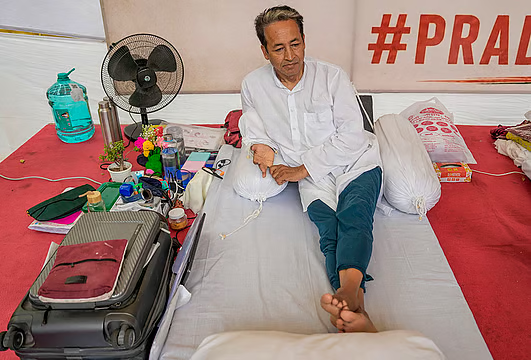
Climate activist Sonam Wangchuk during his indefinite hunger strike, demanding action over alleged examination irregularities and the resignation of Union Education Minister Dharmendra Pradhan, at Jantar Mantar, in New Delhi. Wangchuk is on the 13th day of his hunger strike. (File Photo)
The facts, stripped of the noise
Wangchuk has been fasting at Jantar Mantar since June 28, in solidarity with the Cockroach Janta Party's campaign demanding Union Education Minister Dharmendra Pradhan's resignation over alleged examination-related irregularities. By the third week, he had lost over 8 kg, with reported blood-glucose readings low enough to alarm any treating physician.
Advocate Rakesh Kumar Saini's PIL asks the Delhi High Court to direct the Centre and Delhi government to hospitalise Wangchuk and administer nutrition — by force, if necessary — framing government inaction as complicity that borders on abetment under the Bharatiya Nyaya Sanhita's suicide-abetment provisions.
The Bench of Chief Justice Devendra Kumar Upadhyaya and Justice Tejas Karia has, for now, done the procedurally correct and legally unremarkable thing: it has issued notice, flagged urgency, and sought instructions from the Union. That is not yet judicial intervention on the merits. It is the Court reserving the space to intervene if it concludes intervention is warranted. The real questions arise the moment the Bench has to actually rule on Saini's prayer.
Article 21 pulls in two directions at once
The petition's core theory is that the State owes Wangchuk a positive duty to protect his life — an argument with real constitutional pedigree. Article 21's right to life has long been read to include a right to health and to emergency medical care, and courts have not hesitated to direct hospitals and governments to act where life is at demonstrable risk. If a citizen were collapsing on a footpath from a medical emergency unrelated to his own volition, no one would dispute the State's obligation to intervene.
But Wangchuk's situation is not that. His declining health is the direct, foreseeable, and intended consequence of his own considered choice — a choice he has publicly and repeatedly reaffirmed. This is where the Gian Kaur v. State of Punjab(1996) line of authority becomes unavoidable. A five-judge Bench in Gian Kaur overruled P. Rathinam and held that the right to life under Article 21 does not extend to a right to die, restoring the constitutionality of the erstwhile Section 309 IPC. What is less often quoted from that judgment is why the Court declined to read a right to die into Article 21: not because autonomy doesn't matter, but because the "right to life" as a bundle of positive entitlements — livelihood, dignity, health — cannot logically be inverted into a right to extinguish the very life those entitlements attach to. Force-feeding petitions essentially ask a court to apply that logic in reverse: if there is no right to die, does the State acquire an affirmative right — or duty — to keep a protestor alive against his stated wishes?
Aruna Shanbaug (2011) supplies the closest analogy, though an imperfect one. There, the Supreme Court invoked parens patriae to authorise the Court itself as the ultimate arbiter of what serves an incapacitated patient's welfare, while permitting passive euthanasia in defined circumstances. Wangchuk, unlike Shanbaug, is not incapacitated — he is a competent adult articulating his refusal of food in real time, as a form of political speech. That distinction matters enormously. Parens patriae is a doctrine built for those who cannot decide for themselves; extending it to someone who is deciding, loudly and publicly, risks converting a protective jurisdiction into a coercive one.
Force-feeding is not merely a medical question
Saini's plea seeks a direction to "force feed" Wangchuk liquid nutrition. This is where Indian constitutional law runs headlong into medical ethics and international human rights jurisprudence that Indian courts have historically been reluctant to ignore. The World Medical Association's Malta Declaration on Hunger Strikers — the reference document most medical practitioners and ethics bodies work from — treats force-feeding of a competent, informed hunger striker as a form of inhuman and degrading treatment, precisely because it overrides bodily autonomy through physical coercion. The UN Human Rights Committee has taken a comparable position on the treatment of hunger-striking prisoners of conscience. Any Indian court asked to mandate force-feeding will have to reckon with the fact that "protecting life" through forcible bodily intervention on a mentally competent adult is not ethically or legally neutral — it is itself a form of State violence, merely dressed in humanitarian language.
This is not a hypothetical concern confined to seminar rooms. If the Delhi High Court were to grant Saini's prayer in full, it would be issuing what amounts to a warrant for non-consensual medical procedure against a person who has committed no offence and has not been adjudicated incompetent. That is a significantly graver step than directing that medical facilities and monitoring be made available to Wangchuk — which the State can and arguably should do — versus directing that treatment be imposed on him.
The protest itself sits inside a protected constitutional category
It is worth remembering what is actually happening at Jantar Mantar: a citizen exercising the Article 19(1)(b) right to peaceful assembly and the Article 19(1)(a) right to political expression, in a location that the Supreme Court itself has recognised — in the Ramlila Maidan line of cases arising from the 2011 midnight crackdown on Baba Ramdev's supporters — as constitutionally significant space for dissent. Hunger strikes occupy an uneasy position within that protected category: they are a legitimate, historically resonant form of Gandhian protest, yet they are also acts that place the protestor's own body at risk in a manner ordinary assembly or speech does not.
Courts asked to adjudicate PILs of this kind are effectively being asked to referee between two constitutionally protected but colliding values — the individual's autonomy to protest by risking his own health, and the State's institutional duty not to let a citizen die on a public footpath while it debates jurisdiction.
Where the executive's responsibility actually begins
Strip away the force-feeding prayer, and the more defensible core of the PIL is this: a hunger-striking citizen's medical condition should not go unmonitored because the State has decided that the underlying political demand is unpalatable. There is a meaningful difference between:
Directing the government to ensure continuous, competent medical monitoring, with Wangchuk's informed consent, and make emergency care immediately available should he consent to it or should his mental competence come into genuine question; and
Directing the government to physically compel treatment on an unwilling, competent adult.
The first is squarely within the executive's Article 21 obligations and well within judicial competence to direct. The second edges toward the courts substituting their own risk calculus for the protestor's, and effectively criminalising a form of protest that Indian constitutional culture has otherwise sanctified since before Independence.
What to watch for at tomorrow's hearing
The Bench's eventual order will likely turn on precisely this distinction — between facilitation and compulsion. A well-calibrated order would direct the Centre and Delhi government to depute a medical team to assess Wangchuk, keep him under continuous observation, and stand ready to intervene the moment his condition indicates diminished capacity to consent while stopping well short of authorising force-feeding of a competent adult. Anything broader risks constitutionalising a precedent that could be turned, in a less sympathetic case, against any hunger-striking dissenter the State finds inconvenient. Anything narrower would leave the Court open to the charge that it deferred a genuine life-and-death question purely on account of the Union's absent counsel.
Either way, the adjournment itself is a signal worth noting: a Bench that considered the matter genuinely urgent chose to wait a day rather than pass an interim direction of its own motion. That restraint may be procedurally sound, but it is also, in its own quiet way, an answer to the question the petition raises — that even in matters framed as emergencies, the Court is inclined to let the executive speak first before deciding how far judicial power should reach into a citizen's decision about his own body.