Can BJP Crack Punjab Without the Akalis? Modi's Latest Visit Offers Clues
Is the BJP trying to build its first independent electoral model in Punjab, or is this simply an attempt to improve its position in a state where it still faces significant structural challenges? By Mahima Katal New Delhi, July 16: Prime Minister Narendra Modi's visit to Punjab on July 17 is, on paper, about infrastructure. The inauguration of the redeveloped Jalandhar Cantonment railway station, the launch of a new train named after Guru Ravidass Ji, and the unveiling of railway projects...
Is the BJP trying to build its first independent electoral model in Punjab, or is this simply an attempt to improve its position in a state where it still faces significant structural challenges? By Mahima Katal
New Delhi, July 16: Prime Minister Narendra Modi's visit to Punjab on July 17 is, on paper, about infrastructure. The inauguration of the redeveloped Jalandhar Cantonment railway station, the launch of a new train named after Guru Ravidass Ji, and the unveiling of railway projects under the Amrit Bharat Station Scheme all fit neatly into the Centre's development narrative.
Politically, however, the visit is about something much larger.
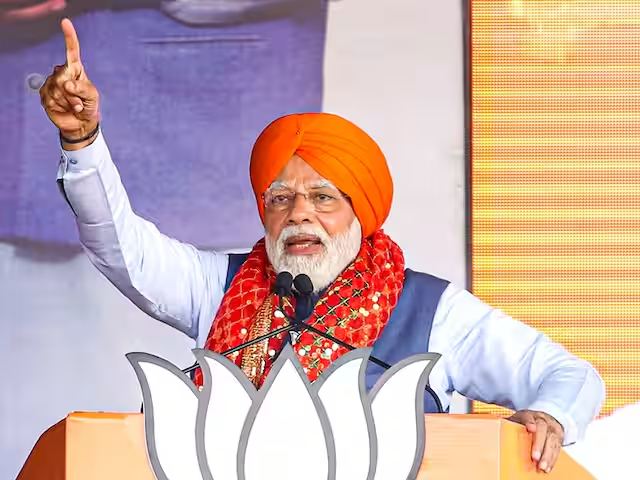
File Image.
For the first time since the Bharatiya Janata Party severed its decades-old alliance with the Shiromani Akali Dal, the Prime Minister is visiting Punjab at a moment when the party has publicly declared that it intends to contest future elections on its own. The question, therefore, is not whether the projects will benefit Punjab. It is whether the BJP is attempting to build its first independent electoral model in a state where it has historically relied on an alliance partner or whether this is simply an effort to improve its bargaining position in one of India's most politically complex states.
The answer lies in how the BJP has recalibrated its strategy since 2020.
For over two decades, the BJP played a complementary role in Punjab politics. While the Shiromani Akali Dal dominated rural Sikh constituencies, the BJP largely confined itself to urban, Hindu-majority seats. The arrangement allowed the party to remain electorally relevant without developing an independent statewide organisation.
The farm laws changed that equation.
The Akali Dal walked out of the National Democratic Alliance over the Centre's agricultural reforms, and the subsequent farmers' movement severely damaged the BJP's standing across Punjab. Overnight, the party found itself without its principal regional ally and with little organisational penetration in rural constituencies.
Since then, the BJP's approach has shifted from coalition politics to organisational expansion.
Instead of relying on the Akalis to mobilise Sikh voters, the party has begun investing in its own outreach. It has inducted Sikh leaders, expanded its presence across districts, increased engagement with religious institutions and attempted to project itself as a party capable of representing Punjab independently.
Modi has become the face of that strategy.
Over the past several years, the Prime Minister has consistently highlighted initiatives connected to Sikh heritage, from the opening of the Kartarpur Corridor and the celebration of Guru Nanak Dev's 550th Prakash Purab to the observance of Veer Bal Diwas, efforts to preserve Sikh heritage, the return of Sri Guru Granth Sahib saroops from Afghanistan and greater engagement with the global Sikh diaspora.
Even during his recent visit to New Zealand, Modi devoted a significant portion of his address to Sikh history and the contribution of the Sikh community, underscoring that this outreach is no longer confined to Punjab but forms part of the BJP's broader political messaging.
The July 17 visit appears to extend that strategy.
The decision to flag off the Shri Guru Ravidass Ji Maharaj Express is politically significant.
Guru Ravidass occupies a revered place in Punjab, particularly among Scheduled Caste communities, and his association with both Punjab and Varanasi allows the BJP to connect cultural symbolism with its development narrative.
Likewise, choosing Jalandhar is unlikely to be incidental.
The Doaba region has long occupied a unique place in Punjab's politics. It has one of the country's largest Scheduled Caste populations, a substantial non-resident Indian community, relatively higher urbanisation and an economy shaped by migration and remittances. Unlike parts of Malwa, where agrarian politics dominates, Doaba presents the BJP with an opportunity to expand among urban, Dalit and aspirational voters.
Development projects therefore serve two purposes.
Administratively, they improve infrastructure.
Politically, they reinforce the BJP's attempt to reposition itself as a party of governance rather than one defined by the controversies surrounding the farm laws.
This shift is particularly important because Punjab remains one of the few major states where the BJP has never emerged as the principal political force. Even at the height of its alliance with the Akali Dal, its electoral footprint remained geographically and socially limited.
The party now appears to believe that sustained central investment, combined with direct engagement by the Prime Minister, can gradually substitute for the social coalition once provided by its regional ally.
Whether that assumption holds remains uncertain.
Punjab's politics has historically been shaped by identity, federal relations, agriculture, water-sharing disputes and regional aspirations as much as by infrastructure and welfare delivery.
The memory of the farm laws continues to influence political perceptions in many parts of the state, particularly among farming communities.
Moreover, the BJP faces competition on multiple fronts.
The Aam Aadmi Party remains in government and continues to project itself as the primary alternative to traditional parties. Congress retains a substantial organisational presence, while the Shiromani Akali Dal, despite its recent electoral setbacks, continues to command influence in sections of the Sikh electorate.
Unlike in several other states where the BJP expanded through organisational growth and charismatic leadership, Punjab presents structural constraints that cannot be addressed through development projects alone.
Yet dismissing the BJP's strategy would be equally premature.
The party is investing political capital in Punjab in a manner not seen before. By combining infrastructure, cultural symbolism and sustained Sikh outreach, it is attempting to create an electoral coalition that no longer depends on the Akali Dal.
The significance of Modi's visit, therefore, lies less in the railway station being inaugurated than in the political message accompanying it.
The BJP wants Punjab's voters to see it not merely as a national party seeking occasional electoral gains, but as an independent political contender capable of governing the state without relying on regional allies.
Whether Punjab's electorate accepts that proposition will become clear only in the Assembly elections. But one conclusion is already evident: the BJP's post-Akali strategy has moved beyond experimentation.
The July 17 visit is another step in what appears to be the party's most ambitious attempt yet to build an independent electoral model in Punjab. Whether that model proves viable or merely improves the BJP's position in a state where it still confronts deep structural challenges will determine whether this outreach marks a political breakthrough or simply another chapter in a long and difficult campaign.