Gyanesh Kumar Row: Protest Everywhere Leads to Nowhere
The road to protests will lead to nowhere if MPs do not give a notice of a motion in either House of Parliament for removal of CEC Gyanesh Kumar facing allegations of favouring the BJP with fresh evidence to back the charges. And if they do, there would be no justification for continuing with the protests.
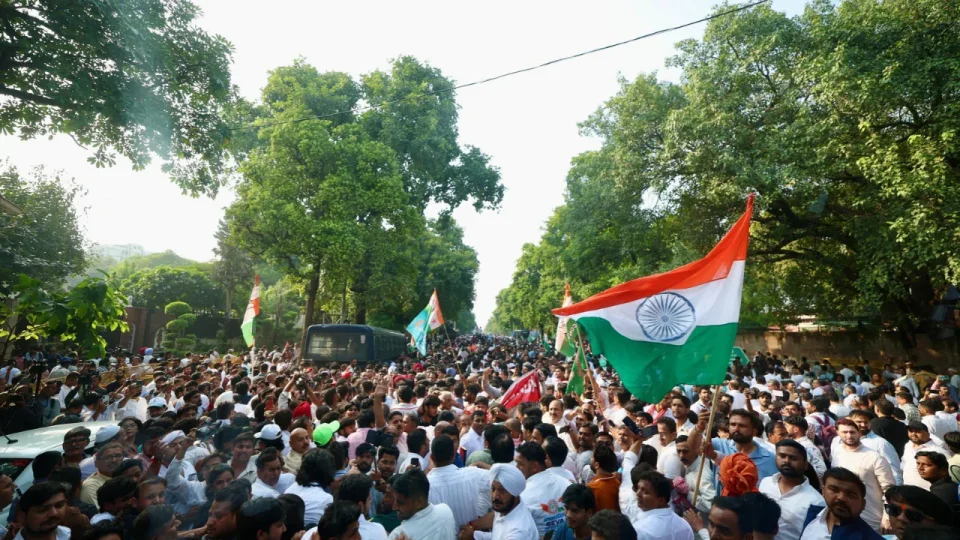
A large number of students and young professionals have taken to the streets against the Chief Election Commissioner (CEC) but Gyanesh Kumar can be removed from the post only if Members of Parliament (MPs) show indulgence by initiating the process for his removal in either House of Parliament in terms of Article 324 of the Constitution.
INDIA bloc MPs may have done more harm than good to democracy by joining the protest against Gyanesh Kumar following recent reports of partisan role played by him, rather than first resorting to the established constitutional mechanism for removing a CEC on the ground of “proved misbehaviour”.
Speaking in the Constituent Assembly on November 25, 1949, Dr. B. R. Ambedkar, while referring to various forms of protests, stressed that “where constitutional methods are open, there can be no justification for these unconstitutional methods”. Though Dr. Ambedkar suggested an end to the expression of political dissent through “civil disobedience, noncooperation and satyagraha” in order to maintain our democracy, our Constitutional scheme envisaged respect for the will of the people. After voting for a government in periodic elections, people can express themselves only through representations and protests.
भारत की गूंज ✊ https://t.co/5mmdcFyBle
— Congress (@INCIndia) October 12, 2026
The protestors may have a reason to take to the streets as only MPs are empowered to initiate action for removing a CEC whose tenure is protected under the Constitution. The road to protests will lead to nowhere if MPs do not give a notice of a motion in either House of Parliament for removal of CEC Gyanesh Kumar facing allegations of favouring the BJP with fresh evidence to back the charges. And if they do, there would be no justification for continuing with the protests.
The Chief Election Commissioner cannot be removed even if all or an overwhelming majority of MPs want him removed. A motion for his removal can be formally moved and voted in Parliament only after the charges against him are proved in an inquiry. And an inquiry can be ordered only after 100 MPs in case of Lok Sabha or 50 MPs in the Rajya Sabha sign a notice of a motion for removal supported by evidence. The Speaker or the Chairman, as the case may be, constitutes an inquiry commission and the process proceeds further only after indictment in the inquiry. The CEC is removed by the President after the motion for removal is backed by at least 2/3rd members present and voting in both the Houses.
The government cannot be the one to ask the CEC to resign even in case of serious charges. In fact, Article 324 seeks to insulate CEC from threat or influence from the government in power. He or she cannot be removed without following the process set out in the Constitution even if he or she is unable to discharge duties efficiently on account of physical or mental incapacity.
The constitutional protection is primarily to shield the CEC from coming under the influence of the government or the political party or alliance ruling at the Centre. Permitting or asking the Central government to seek resignation of CEC would amount to subversion of the Constitutional scheme and compromise the very office of CEC.
The government hardly has any option. The NDA, INDIA bloc or other MPs can initiate the process for removal if they feel that the charges are valid and the demand is legitimate. An inquiry can be initiated only after MPs give a notice of a motion for removal along with evidence of misbehaviour. A move in this direction may give a quietus to the whole controversy.
The only answer to the outrage is to initiate the process for removal of the CEC. The MPs who find substance in the allegations need to exercise the constitutional option. Any support to the demand for resignation of CEC Gyanesh Kumar will make serious inroads into the constitutional scheme which insulates CEC from political influence to ensure conduct of free and fair elections.
The constitutional safeguards would be meaningless if political parties seek or support the demand for resignation of CEC even if it is on charges of alleged misbehaviour. Such a step is bound to put immense pressure and coerce the CEC to resign. This would open doors for bypassing the rigorous process of removal by mobilizing people on the streets to get rid of an inconvenient CEC by forcing him to resign to save himself from embarrassment. A group of protestors on the streets can do what all Parliamentarians together cannot do -- remove a CEC even without charges of misconduct being proved.
We’re putting forward 3 clear demands: 1. Gyanesh Kumar’s resignation and initiation of criminal proceedings against him. 2. Freeze SIR & restore the January 2025 voter list. 3. Repeal the 2023 law & reform the Election Commission. https://t.co/4zELnMymfw
— Cockroach Janta Party - CJP (@Cockroachisback) September 24, 2026
The ongoing protest is justified as long as it is a peaceful democratic expression to draw the attention of the ruling dispensation as well as the opposition towards the alleged charges against Gyanesh Kumar. But it cannot be justified as a means to subvert rule of law by compelling the acceptance of demands through a show of strength.
The process for removal of Gyanesh Kumar needs to be initiated in Parliament by MPs who find merit in the demand. This should put an end to the protests. Quashing an increase in reservation following a 'fast protest' by students in Delhi University, eminent jurist and Supreme Court judge, Justice V R Krishna Iyer stressed in a judgment [1980 (2) SCC 768] that protests could not be permitted if “democratic mechanisms were alive and not impervious to legitimate grievances”. Dr. Ambedkar’s view in the Constituent Assembly echoes in Justice Iyer’s judgment which draws a Lakshman Rekha for protestors.
The INDIA bloc MPs may have crossed the line by joining protestors on the streets. They ought to have considered that numbers in a democracy count only in elections. It is the Rule of Law which is the life breath of democracy. And the right to protest cannot outlive democracy.