Congress Fails to Bag Any Seat in Karnataka; A Test of Its Electoral Strategies
Congress Loses All Karnataka MLC Seats: Congress fails to win any of the four Karnataka MLC seats as the BJP-JD(S) alliance sweeps the polls, raising questions about the ruling party's electoral strategy and organisational strength.
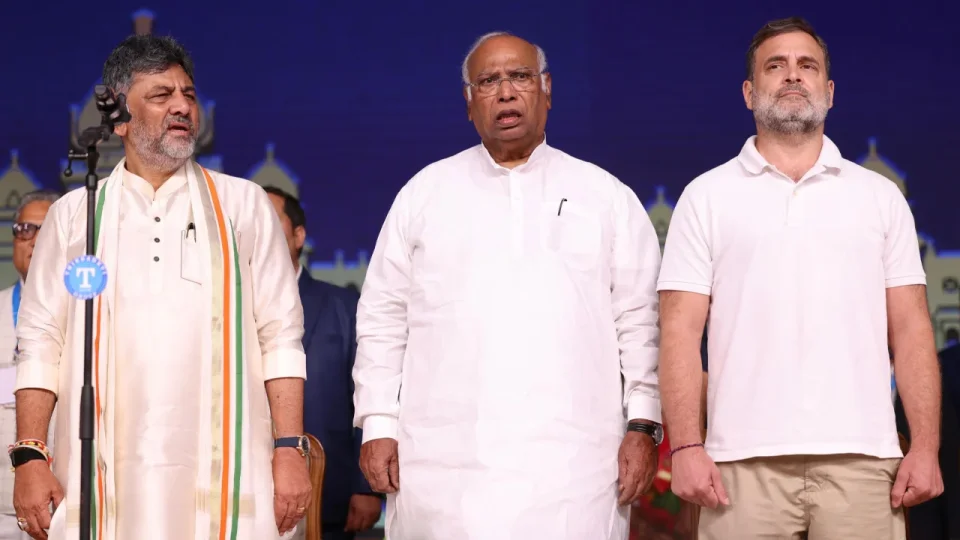
Congress Loses All Karnataka MLC Seats: While the Congress leadership at the national level has stepped up its campaign against Chief Election Commissioner Gyanesh Kumar, the party has struggled to secure a single seat in Karnataka, where it is in power. The results of the Legislative Council elections have put the spotlight on the party's state organisation, led by Deputy Chief Minister DK Shivakumar, and its ability to mobilise support among teachers and graduate voters. The biggest setback came in the Bengaluru Teachers' constituency, where sitting Congress MLC Puttanna lost to JD(S) candidate AP Ranganath by 908 votes. The BJP-Janata Dal (Secular) alliance swept all four seats in the state.
The defeat raises questions about Congress's ability to mobilise support beyond Assembly elections. It also gives the BJP-JD(S) alliance an opportunity to present itself as a strong challenger ahead of the next Karnataka Assembly election, expected in 2028.
Meanwhile, Karnataka Chief Minister and senior Congress leader DK Shivakumar welcomed the judgement on Wednesday and vowed to look into the vaccum in the election strategy that cost the party seats that were previously held by its leaders. “Whatever decision the voters give in the Parishad elections, we will accept it with respect. We had one seat. We expected that even one or two seats we would win, but that didn’t happen. The people have given us a message. We will examine that message very carefully and think about it, and we will work on correcting whatever went wrong,” Shivakumar said.
Also Read: Drones Take Centre Stage in India's Defence Shopping List Amid China Concerns
Karnataka: Why the BJP-JD(S) Sweep Matters
Karnataka is the most important state in this round of elections for Congress because the party is in power there. Losing all four seats, including one previously held by a sitting Congress member, is a setback for both its state leadership and its electoral strategy. The most significant defeat came in the Bengaluru Teachers' constituency where Ranganath secured 10,810 votes, against Puttanna's 9,902.
The result matters for two reasons. First, Congress lost a seat it already held, suggesting that its existing political networks were not enough to secure victory. Second, the BJP and JD(S) demonstrated that their alliance could work effectively in a state where Congress is the ruling party. The BJP retained the other three constituencies. Shashil G Namoshi won the North-East Teachers' seat, SV Sankanur secured the West Graduates' constituency, and KM Suresh won the South-East Graduates' seat.
Namoshi's victory is also noteworthy because his constituency includes Kalaburagi, the home region of Congress president Mallikarjun Kharge. Congress had attached importance to these elections. DK Shivakumar had directed ministers to campaign in the constituencies, underlining the effort the party put into the contest. Yet, that effort did not translate into a single victory.
The result raises an important question for the Congress government: has it managed to turn its position in power, its welfare guarantees and its organisational presence into electoral support among teachers and graduates? It is too early to conclude that the government has lost wider public support. However, the results suggest that holding office does not automatically guarantee success in every election, particularly when the opposition works together.
Also Read: Japan Explores India as a Training Ground for Long-Range Missiles
For the BJP and JD(S), the sweep provides a morale boost. Their leaders can use the results to argue that the alliance has the potential to challenge Congress in the next Assembly election. Union Minister and JD(S) chief HD Kumaraswamy has already presented the outcome as a mandate pointing towards 2028.
Why are Legislative Council Elections Different from Assembly polls?
To understand the significance of Congress's defeat, it is important to understand how these elections work. Legislative Councils are the upper houses of state legislatures in states that have them. Unlike Assembly elections, graduates' and teachers' constituencies have a restricted electorate made up of eligible, registered voters from these professional groups. This means that candidates often depend heavily on their personal standing, relationships with voters, local organisational networks and direct campaigning. The transfer of preferences under the preferential voting system can also affect the final outcome.
As a result, these elections do not provide a complete picture of public opinion across a state. For example, a party may perform poorly in a teachers' constituency because its candidate has weaker local support, even if the party remains popular among the wider electorate. Similarly, a strong candidate with an established network may win despite belonging to a party that is less influential in the state as a whole.
But this does not mean the results can be ignored. Elections involving a smaller electorate can still reveal weaknesses in a party's organisation, candidate selection and ability to mobilise particular groups of voters. In Karnataka, Congress's defeat is especially significant because it lost all four seats despite being in government and actively campaigning for the elections.
The key question is not whether these elections predict the next Assembly results. It is whether Congress recognises the organisational weaknesses exposed by the defeat and addresses them before the next major electoral contests.