As Gaza Braces for Winter, Israel Cuts Commercial Supplies, Leaving Millions Facing Food Uncertainty
Israel's suspension of commercial shipments to Gaza sparks concerns over food security, market prices and the territory's dependence on humanitarian aid.
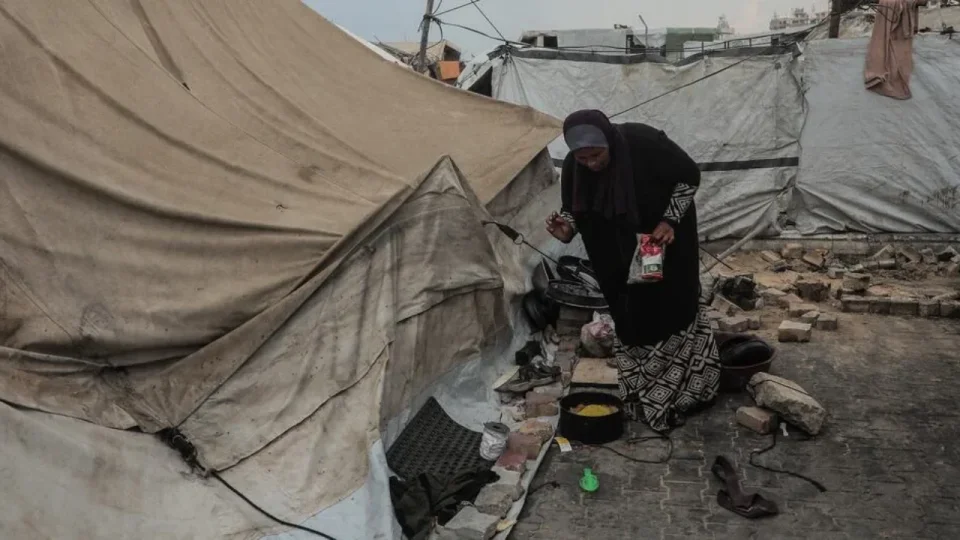
Israel has announced that commercial goods will no longer be allowed into the Gaza Strip, cutting off an important source of food and shelter supplies for the war-torn territory ahead of the winter seaon. Humanitarian groups warn that aid delivery only is not enough to facilitate the the population of Gaza, as they are facing severe food shortage. They say commercial markets must also be allowed to operate so that people can access essential goods at affordable prices.
The Coordination of Government Activities in the Territories (COGAT), the Israeli military body responsible for overseeing humanitarian affairs in Gaza, on Wednesday announced the suspension. It did not clarified who gave the orders, but mentioned that the decision stemmed from a statement from Gaza's local merchants, who had reportedly decided to stop shipments. Palestinian representatives have disputed this claim, saying Israel was responsible for the restrictions.
The suspension could significantly reduce the supplies entering Gaza, which depends heavily on goods brought through border crossings controlled by Israel. With commercial shipments halted, concerns have also grown over rising prices and the availability of essential items such as food and shelter materials.
Humanitarian workers have warned that aid deliveries alone may not be enough to meet the needs of Gaza's population. “The humanitarian sector on its own cannot meet the needs of all the people,” said Shaina Low, a spokesperson for the Norwegian Refugee Council, an aid organisation. “The markets need to be functioning.”
Earlier this year, the world's leading authority on food insecurity reported that conditions in Gaza had improved since famine was declared in the territory in August 2025. However, food insecurity remained at crisis levels, with most families still unable to obtain enough food.
The report warned that even a small disruption to humanitarian access could quickly reverse the progress made in improving food security.
Israel Blames Local Merchants, Palestinians Dispute Claim
In its announcement, COGAT said local merchants in Gaza had decided to stop commercial shipments because they were tired of Hamas imposing charges on their trucks and threatening them. Israel has repeatedly accused Hamas of collecting fees on imported goods to finance its operations.
However, Nahed Sheheiber, head of Gaza's private truckers' union, rejected Israel's explanation. He said the decision had been taken by Israel and not by Gaza's merchants.
“The merchants are not the ones who stopped the shipments,” he said. “The Israeli coordinator is claiming that Gaza's merchants are responsible, but the truth is that the Israelis are the ones who imposed the restrictions.”
Following COGAT's announcement, Sheheiber's union met representatives of Gaza's Ministry of Economy to raise concerns over the suspension. The union alleged that Israel was using fees imposed by the ministry as a reason to restrict the entry of commercial goods.
According to Sheheiber, the ministry had asked merchants to pay 10,000 Israeli shekels, or approximately USD 3,226, for every truck entering Gaza.
During the meeting, Khaled Al-Raqab, the ministry's undersecretary, said the amount was not a tax. He described it as a donation requested by the ministry to help pay civil servants working in Gaza.
It remains unclear whether humanitarian organisations will be permitted to increase aid deliveries to make up for the loss of commercial supplies. COGAT's announcement did not clarify whether additional humanitarian shipments would be allowed into the territory.
Gaza Faces Uncertainty Over Food Supplies
COGAT said Gaza's population of approximately two million people required around 250 truckloads of goods every day. However, this figure is significantly lower than the minimum of 600 trucks a day stipulated under a ceasefire agreement brokered by the United States a year ago.
The suspension of commercial shipments has raised concerns about whether Gaza will receive enough supplies to meet the population's basic needs, particularly as winter approaches. Aid agencies have repeatedly stressed that both humanitarian assistance and functioning commercial markets are necessary to prevent further deterioration in living conditions.
The war began on October 7, 2023, when Hamas-led militants attacked Israel, killing around 1,200 people and taking 251 hostages. Israel responded with an extensive bombing campaign and a ground invasion of Gaza.
According to Gaza's Health Ministry, more than 74,000 Palestinians have been killed since the war began. The figure includes more than 1,400 Palestinians killed since the ceasefire came into effect, the ministry says. Five Israeli soldiers have also been killed in Gaza during the same period in sporadic attacks.
The Health Ministry operates under the Hamas-run government in Gaza. It maintains detailed records of deaths and is generally regarded as a reliable source by United Nations agencies and independent experts. However, its figures do not distinguish between civilians and combatants. The ministry says women and children account for around half of those killed.
(With AP Inputs)